The New Digital Drill: How Artificial Intelligence is Reshaping Dentistry
Published 21 min read
Introduction to AI in Modern Dentistry
Artificial intelligence is no longer a futuristic concept sitting in the background of healthcare — it is actively moving into dental offices, clinics, and specialty practices right now. What once seemed like experimental technology is becoming part of routine dental workflows, particularly in areas like imaging analysis, diagnostics, and practice management. AI-powered tools are being used to scan radiographs for early signs of decay, flag potential issues in CBCT scans, and even help front desk staff manage patient scheduling. The shift is real, it is happening fast, and it is changing what a modern dental practice looks like from the inside out.
Understanding why this matters requires looking at the bigger picture of where dentistry is headed. Dental professionals are under increasing pressure to see more patients, document more thoroughly, and deliver more consistent care — all while keeping up with advances in clinical knowledge. AI offers a way to support those demands without sacrificing quality. From clinical decision support tools to automated patient communication platforms, AI is touching nearly every specialty in dentistry. That is exactly why this topic deserves serious attention from clinicians, students, and anyone who cares about the future of oral health care.
What Is Artificial Intelligence in Dentistry?
At its core, artificial intelligence refers to computer systems that are designed to perform tasks that normally require human thinking — things like recognizing patterns, making predictions, or interpreting complex data. In dentistry, it helps to understand the distinction between a few related terms. Machine learning is a type of AI where algorithms learn from large datasets and improve their performance over time without being explicitly programmed for every scenario. Augmented intelligence, a term increasingly used in clinical settings, refers specifically to AI that is designed to enhance human decision-making rather than replace it. This distinction is important because most dental AI tools fall into the augmented intelligence category — they are built to work alongside dentists, not instead of them.
The data that powers AI in dentistry is drawn from a wide variety of clinical sources. Radiographs — including bitewings, periapicals, and panoramic images — are among the most commonly used inputs because they contain rich visual information about tooth structure, bone levels, and pathology. Intraoral photographs, CBCT scans, cephalometric images, and even written chart notes and treatment records can all be fed into AI systems. By analyzing thousands or even millions of examples of these data types, AI algorithms learn to identify patterns that might be easy to miss during a busy clinical day. The more diverse and high-quality the training data, the more reliable the AI output tends to be.
Why Dentistry Is Adopting AI So Quickly
Several factors are driving the rapid adoption of AI across dental practices. One of the biggest is speed — AI can analyze a full-mouth series of radiographs in seconds and flag areas of concern before the dentist has even sat down with the patient. Beyond speed, there is the matter of consistency. Human clinicians, no matter how experienced, can have off days, experience fatigue, or simply miss a subtle finding under time pressure. AI does not get tired, and it applies the same analytical criteria every single time. Add to that the ability to process enormous amounts of clinical data that no individual clinician could realistically review alone, and it becomes clear why so many practices are taking a closer look at what these tools can do.
Authoritative dental organizations and peer-reviewed literature have increasingly acknowledged AI's growing role in clinical dentistry, though they are careful to frame it as a support tool rather than a replacement for professional judgment. Reviews published in major dental journals emphasize that AI is most valuable when it assists clinicians — helping them catch what they might miss, organize information more efficiently, and make more informed decisions. The message from trusted sources is consistent: AI should enhance the dentist's capabilities, not override them. That framing has helped ease concerns within the profession and encouraged more clinicians to explore what AI adoption might look like in their own practices.
How AI Supports Dental Diagnosis
One of the most exciting and well-developed applications of AI in dentistry is diagnostic imaging analysis. AI algorithms have been trained to detect a wide range of conditions directly from dental images, including interproximal caries, periapical lesions, periodontal bone loss, calculus deposits, and even early signs of oral lesions. These tools work by comparing a patient's images against thousands of annotated examples the algorithm has already learned from, flagging areas that match patterns associated with pathology. In a busy practice where a clinician might be reviewing dozens of radiographic images in a single day, having an AI tool highlight areas of concern can be a meaningful safety net.
Beyond simply spotting individual findings, AI excels at pattern recognition across complex datasets. This makes it particularly useful for screening purposes — identifying patients who may need a closer look — and for providing a kind of second opinion that does not require calling in a colleague. Early detection is one of the most significant advantages. Catching a small carious lesion before it progresses to pulp involvement, or identifying early bone loss before it becomes advanced periodontal disease, can dramatically change a patient's treatment trajectory and long-term oral health outcomes. AI gives clinicians a sharper set of eyes, especially for the subtle findings that are easy to overlook.
In terms of accuracy, the research is encouraging. Recent systematic reviews and meta-analyses have reported strong diagnostic performance for AI tools across multiple dental specialties, with some tools matching or approaching the accuracy of experienced clinicians in controlled studies. However, it is equally important to acknowledge the limitations. Performance can vary depending on image quality, the diversity of the training data, and the clinical setting in which the tool is deployed. That is why human oversight remains non-negotiable. AI outputs should be reviewed and interpreted by a licensed dental professional who can apply clinical context, patient history, and professional judgment to any finding the algorithm surfaces.
AI in Treatment Planning and Clinical Decision Support
Diagnosis is just the beginning — AI is also making its way into treatment planning across virtually every dental specialty. In orthodontics, AI tools can analyze skeletal and dental relationships to suggest treatment approaches and predict how teeth will move over time. In prosthodontics, algorithms can help design restorations based on occlusal data and esthetic parameters. Endodontic AI tools can assist with root canal morphology analysis, while periodontal applications can help clinicians track disease progression and plan surgical or non-surgical interventions. The common thread across all of these specialties is that AI can process complex, multivariable data and present clinicians with structured, evidence-informed pathways to consider.
Perhaps one of the most compelling aspects of AI-assisted treatment planning is the ability to visualize outcomes before a single instrument touches a patient's mouth. Predictive models and digital simulations allow dentists to show patients what their results might look like after orthodontic treatment, implant placement, or full-mouth rehabilitation. This kind of visual forecasting is not just a nice feature — it is a clinical tool. When a dentist can model different treatment scenarios and compare predicted outcomes side by side, it leads to better-informed decisions and more realistic patient expectations. It also creates a record of the planning process that can be referenced throughout treatment.
That said, it is worth being clear about the boundaries of what AI should and should not do in a clinical setting. Many authoritative sources in dentistry are explicit on this point: AI should inform decisions, not make them. A treatment plan generated or suggested by an algorithm still needs to be evaluated by a dentist who understands the full clinical picture — the patient's medical history, their preferences, their financial situation, and the nuances of their oral anatomy. AI is a powerful input into that decision-making process, but the final call belongs to the clinician. Practices that adopt AI with that understanding in place are the ones most likely to use it safely and effectively.
AI and Digital Imaging in Dentistry
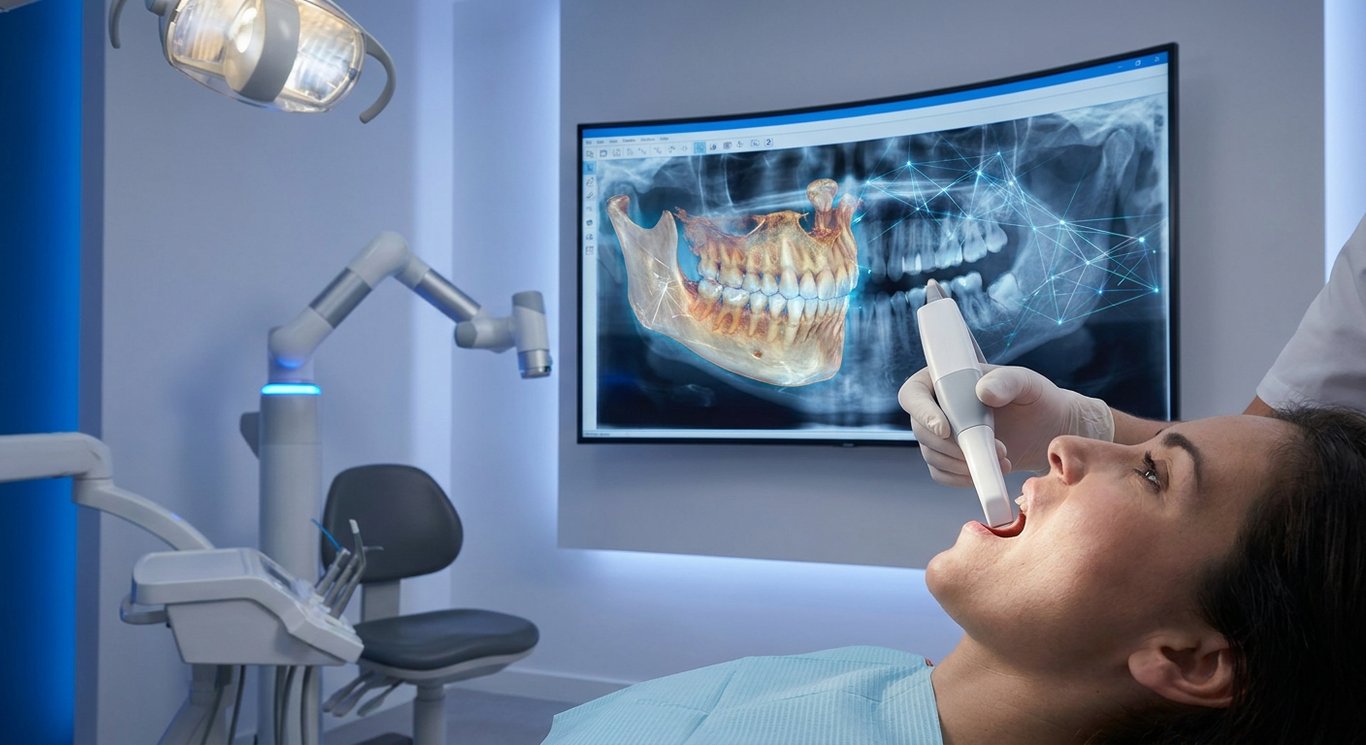
Digital imaging has already transformed dentistry over the past two decades, and AI is now taking that transformation to the next level. Radiographic analysis is the most mature application, with AI tools capable of reviewing bitewing and periapical radiographs with impressive speed and detail. But the technology extends well beyond standard X-rays. CBCT scans — which produce three-dimensional images of the jaw, teeth, and surrounding structures — generate enormous amounts of data that can be difficult and time-consuming for clinicians to analyze manually. AI can help by automatically segmenting structures, identifying landmarks, and flagging regions of interest for closer review. Cephalometric analysis and intraoral scanning are also areas where AI is adding real value, reducing the time required for manual measurements and improving the precision of landmark identification.
The practical impact of AI-enhanced imaging goes beyond speed. When AI tools are integrated into imaging workflows, they can help dentists catch findings that might have been missed during a routine review — not because the clinician was careless, but because subtle pathology can be genuinely hard to detect, especially in early stages. Improved detection rates mean earlier intervention, which is almost always better for the patient. There is also a documentation benefit: AI tools can automatically annotate images, flag findings, and generate structured reports that become part of the patient's clinical record. This supports better continuity of care and makes it easier for other providers to understand a patient's history at a glance.
AI in Orthodontics and Smile Design
Orthodontics is one of the specialties where AI has found some of its most practical and widely adopted applications. Cephalometric landmark identification — a task that traditionally required a trained clinician to manually mark dozens of anatomical points on an X-ray — can now be completed by AI in a matter of seconds with a high degree of accuracy. Tooth movement prediction is another area where AI is making a genuine difference, allowing orthodontists to model how teeth will respond to different forces over time. Aligner planning software increasingly uses AI to optimize staging and predict the number of aligners a patient will need. These tools do not eliminate the orthodontist's role — they make that role more efficient and data-driven.
On the cosmetic and patient communication side, AI-powered digital smile design tools are changing the way clinicians discuss treatment options with patients. By analyzing facial photographs and dental images, these systems can generate realistic simulations of potential outcomes — showing a patient what their smile might look like after veneers, whitening, orthodontic treatment, or implant restoration. This kind of visual storytelling is powerful in a consultation setting. Patients who can actually see a projected outcome are better equipped to give informed consent, ask meaningful questions, and feel confident in the treatment decisions they are making. It turns what was once an abstract conversation into something concrete and tangible.
AI in Dental Practice Management and Administration
Clinical applications get most of the attention, but AI is also quietly revolutionizing the business side of running a dental practice. Scheduling tools powered by AI can analyze appointment patterns, predict cancellations, and optimize the daily schedule to reduce downtime and improve patient flow. Automated patient communication systems can send appointment reminders, follow-up messages, and post-treatment instructions without requiring staff to make individual phone calls. AI-assisted documentation tools can help clinicians generate chart notes faster, reducing the time spent on administrative tasks at the end of a busy day. Billing support tools can flag coding errors, identify missing documentation, and help practices submit cleaner claims — which translates directly to faster reimbursement and fewer denials.
The operational benefits of these tools add up quickly. When staff spend less time on repetitive administrative tasks, they have more capacity to focus on patient experience and clinical support. Practices that have integrated AI into their front office workflows often report meaningful reductions in no-show rates, faster check-in processes, and improved patient satisfaction scores. From a business perspective, these efficiency gains can have a real impact on revenue and team morale. The best administrative AI tools are the ones that work quietly in the background — handling the routine so that the humans in the practice can focus on the things that actually require human judgment and care.
Benefits of AI for Dentists and Patients
The clinical benefits of AI in dentistry are substantial and span multiple dimensions of care. Earlier detection of pathology is perhaps the most significant — catching a carious lesion, a periapical abscess, or early bone loss before it progresses gives clinicians more treatment options and patients better outcomes. Improved consistency means that every patient receives the same level of analytical scrutiny, regardless of how busy the clinic is or how experienced the clinician reviewing their images happens to be. Better forecasting through predictive models allows dentists to anticipate complications, plan more accurately, and set realistic expectations. And more personalized treatment planning — informed by AI analysis of a patient's specific anatomy and history — means care that is tailored rather than generic.
Patients also benefit in ways that go beyond the clinical. When AI tools generate visual simulations of treatment outcomes, patients gain a clearer understanding of what their care will involve and what they can realistically expect. This improves informed consent and reduces anxiety. Faster service — whether through quicker diagnostic turnaround or more efficient scheduling — means less time waiting and more time receiving care. And as AI helps practices streamline their workflows, the patient experience often improves across the board, from the ease of booking an appointment to the clarity of post-treatment communication. In short, what is good for clinical efficiency tends to be good for the patient experience too.
There is also a broader access-to-care dimension worth considering. AI-assisted analysis tools can help smaller or under-resourced clinics perform at a higher level without requiring additional specialist staff. In areas where access to dental specialists is limited, AI-powered screening tools could help general dentists identify patients who need referrals more reliably and earlier. By helping practices scale their analytical capacity without proportionally scaling their costs, AI has the potential to make quality dental care more accessible to more people — a benefit that extends well beyond individual practices and into public health.
Risks, Limitations, and Ethical Concerns
Like any powerful technology, AI in dentistry comes with real risks that deserve honest discussion. False positives — where AI flags a finding that turns out not to be pathological — can lead to unnecessary anxiety, additional testing, and potentially overtreatment. False negatives — where the algorithm misses a genuine finding — are perhaps even more concerning because they can create a false sense of security. Model bias is another serious issue: if an AI system was trained predominantly on data from one demographic group or imaging system, its performance may be significantly worse when applied to different patient populations or equipment. Overreliance on automated outputs, without sufficient critical evaluation by the clinician, is a risk that grows as AI tools become more familiar and trusted.
Data privacy and regulatory compliance are equally important concerns. AI tools in dentistry process sensitive patient health information, which means they must comply with applicable privacy laws and regulations — including HIPAA in the United States and equivalent frameworks in other countries. Informed consent is another ethical consideration: patients should understand when AI tools are being used in their care, what data is being analyzed, and how the outputs are being used to inform clinical decisions. There is also the question of validation — not all AI tools on the market have been rigorously tested in real clinical environments, and the gap between performance in a controlled research setting and performance in a busy dental practice can be significant.
Many trusted dental organizations and clinical experts are consistent in their guidance on this point: human oversight is not optional, it is essential. AI tools should be selected carefully, with attention to their evidence base, their regulatory status, and their fit with the specific clinical environment in which they will be used. Clinicians should never treat AI output as a final answer — it is a starting point for clinical reasoning, not a replacement for it. Practices that approach AI adoption with a clear clinical purpose, a commitment to ongoing evaluation, and a culture of critical thinking are far better positioned to use these tools safely and effectively than those that adopt them simply because they are new.
How Dentists Can Choose the Right AI Tools
Choosing an AI tool for a dental practice is not a decision that should be made based on marketing materials alone. Clinicians evaluating AI products should look for evidence of clinical validation — ideally published in peer-reviewed literature or supported by robust internal studies — that demonstrates the tool performs reliably in real-world settings similar to their own. Workflow integration matters enormously: a tool that requires significant manual data entry or disrupts existing systems is unlikely to be used consistently, no matter how accurate it is. Patient population fit is another key consideration — a tool trained primarily on adult patients may not perform as well in a pediatric practice, for example. And regulatory compliance is non-negotiable; any AI tool used in clinical care should meet the relevant standards for the jurisdiction in which the practice operates.
Beyond the technical checklist, the best AI tools share a common characteristic: they make the dentist better without taking over. The ideal tool surfaces findings, suggests possibilities, and organizes information in a way that supports the clinician's decision-making process — while always leaving room for the dentist to review, question, and override the output. Tools that are transparent about how they reach their conclusions, that provide confidence scores or uncertainty indicators, and that are designed with clinical workflow in mind tend to earn lasting trust from the practitioners who use them. Ultimately, the goal is not to find the most impressive-sounding technology — it is to find the tool that genuinely improves care for the patients sitting in the chair.
The Future of AI in Dentistry
The trajectory of AI in dentistry points toward tools that are more integrated, more predictive, and more personalized than what exists today. Stronger predictive analytics will allow clinicians to identify patients at high risk for caries, periodontal disease, or implant failure before those conditions develop — shifting the focus from reactive treatment to proactive prevention. Imaging tools will continue to improve in resolution and analytical depth, making it possible to detect pathology at even earlier stages. Deeper integration into digital workflows — connecting imaging software, practice management systems, electronic health records, and patient communication platforms — will create a more seamless clinical environment where AI insights are available at every point of care rather than siloed in a single application.
Looking further ahead, AI is likely to expand its footprint across every dental specialty while the dentist's central role remains firmly intact. The technology will get smarter, the datasets will get larger, and the tools will become more intuitive — but the clinical judgment, the patient relationship, and the ethical responsibility will always belong to the human professional. The most optimistic and realistic vision of AI in dentistry is not one where machines replace clinicians, but one where clinicians are empowered by machines to do their best work more consistently, more efficiently, and for more patients than ever before. That is a future worth working toward.
FAQ: Common Questions About AI in Dentistry
1. What is artificial intelligence in dentistry?
Artificial intelligence in dentistry refers to the use of computer systems and algorithms to analyze dental data, support clinical diagnosis, assist with treatment planning, and automate routine administrative tasks. These systems learn from large collections of dental images, records, and clinical data to identify patterns and provide useful outputs — such as flagging a potential cavity on a radiograph or suggesting a treatment pathway based on a patient's history. The goal is to give dental professionals a smarter, faster set of tools to work with, not to replace the clinical expertise they bring to every patient interaction.
2. Can AI replace dentists?
No — and it is not designed to. AI in dentistry is built to assist clinicians, not replace them. The technology can analyze images, flag findings, and suggest options, but it cannot examine a patient, apply clinical judgment, understand a patient's full medical and personal context, or take professional responsibility for a treatment decision. Final decisions must always remain with the licensed dental professional. Think of AI as a very capable assistant that helps the dentist work more efficiently and catch things that might otherwise be missed — not as a substitute for years of training and hands-on clinical experience.
3. How accurate is AI for dental diagnosis?
Many studies and systematic reviews have shown that AI tools — particularly those designed for radiographic analysis — can achieve strong diagnostic accuracy, sometimes approaching or matching the performance of experienced clinicians in controlled research settings. However, accuracy is not a fixed number. It depends on the quality of the images being analyzed, the diversity of the data the algorithm was trained on, the specific condition being detected, and the clinical environment in which the tool is used. No AI tool is perfect, which is why human review of all AI-generated findings remains a critical part of the diagnostic process.
4. Is AI safe to use with patient data?
Safety in this context depends on several factors working together. AI tools used in dental practices must comply with applicable data privacy regulations — such as HIPAA in the United States — and should use secure, encrypted systems for storing and transmitting patient information. Patients should be informed when AI tools are part of their care and should have the opportunity to ask questions about how their data is used. Practices should only use AI products from vendors who can demonstrate compliance, security, and a clear data governance framework. When those conditions are met, AI can be used responsibly and safely as part of modern dental care.
5. What are the biggest benefits of AI in dentistry?
The benefits of AI in dentistry span both the clinical and operational sides of practice. On the clinical side, the most significant advantages include faster and more consistent diagnosis, earlier detection of pathology, better-informed treatment planning, and improved ability to predict and visualize outcomes. For patients, AI can mean clearer explanations of their condition and treatment options, faster service, and more personalized care. On the operational side, AI can reduce administrative burden, improve scheduling efficiency, and support better documentation and billing practices. Together, these benefits make AI one of the most impactful developments in modern dentistry.
Conclusion
Artificial intelligence is not coming to dentistry — it is already here. From radiographic analysis and periodontal screening to orthodontic planning and automated scheduling, AI is actively reshaping how dental care is delivered, documented, and experienced. The tools available today are genuinely impressive, and the research supporting their use continues to grow. At the same time, this technology comes with real responsibilities. Clinicians who adopt AI must do so thoughtfully, with attention to validation, data privacy, patient consent, and the irreplaceable role of human judgment in clinical decision-making. The promise of AI is real, but so are the risks of using it carelessly.
If this article has sparked your curiosity, the next step is to keep exploring The New Digital Drill: How Artificial Intelligence is Reshaping Dentistry — because understanding this shift is quickly becoming essential for anyone working in or receiving dental care. The key takeaways are worth repeating: AI is a powerful technology with meaningful applications across every dental specialty, from imaging and diagnostics to practice management and patient communication. It works best not as a standalone solution, but as a partner to skilled dental professionals who bring clinical expertise, ethical judgment, and genuine human care to every patient they treat. The future of dentistry is digital — and the dentists who thrive in it will be the ones who learn to work with AI wisely.