The Modern Dental Office: A Guide to the Technology Transforming Your Care
Published 27 min read
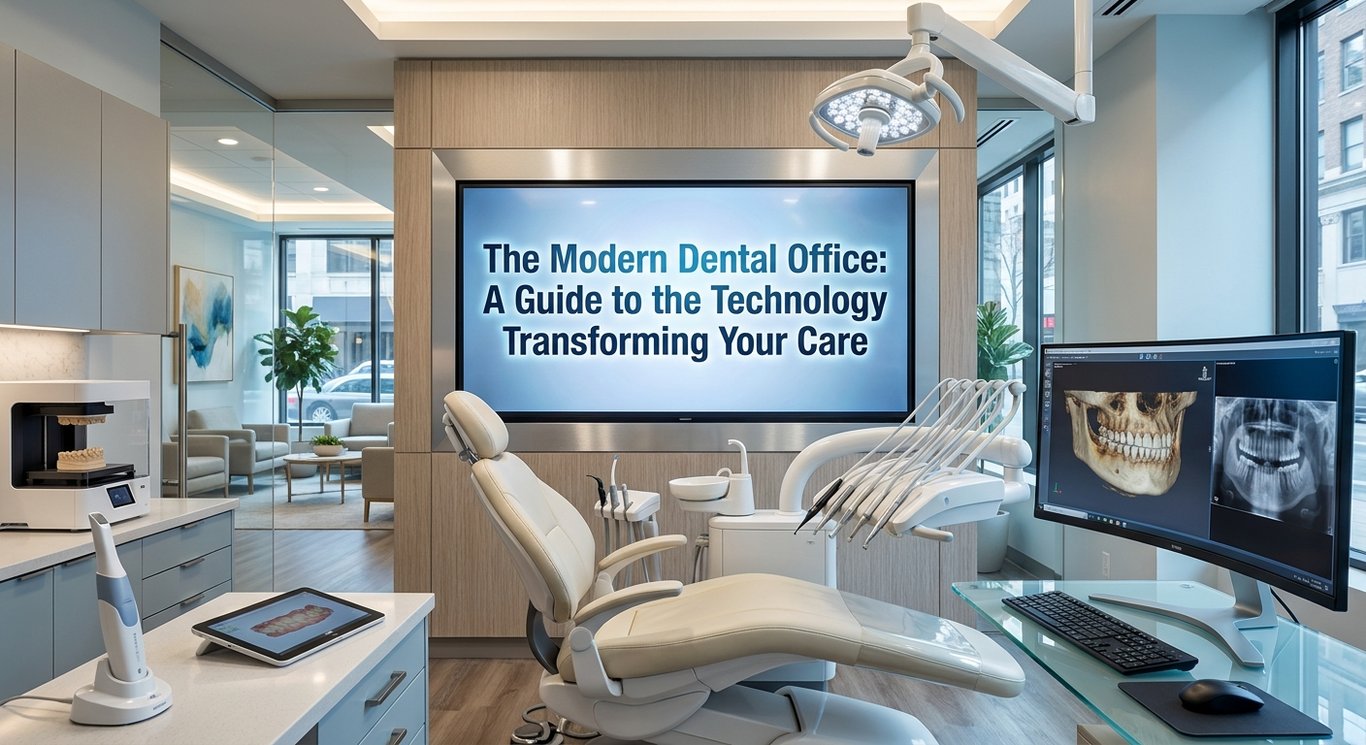
Walking into a dental office today looks and feels very different from what it did even a decade ago. Instead of film X-rays and trays of putty-like impression material, you might find digital scanners, computer screens displaying 3D models of your teeth, and software that helps your dentist plan treatment with remarkable detail. These digital tools are changing nearly every part of the dental experience — from how a cavity is detected to how a crown is made to how you schedule your next appointment. Importantly, none of this technology replaces the trained eye and clinical judgment of your dentist. It supports it, giving your care team better information and more efficient ways to act on it.
This guide covers the major technologies reshaping dental care today. You'll learn about digital imaging, intraoral scanning, CAD/CAM restorations, 3D printing, artificial intelligence, teledentistry, electronic health records, and the systems designed to keep patients safe and comfortable. Whether you're curious about what that handheld scanner actually does or wondering if AI is really reading your X-rays, you'll find clear, honest answers here.
What Is a Modern Dental Office?
Digital dentistry refers to the use of computer-based tools and connected systems throughout the dental practice. Instead of relying on physical film, paper charts, and manual processes, a digitally integrated office captures patient information electronically — from X-ray images to treatment notes to impressions of your teeth. These systems can store, analyze, and share that information quickly and securely, making it easier for your dental team to coordinate your care. Think of it as the difference between a paper filing cabinet and a searchable, shareable digital database that's available the moment it's needed.
Beyond efficiency, this kind of integration can genuinely improve the quality of your experience. Diagnoses can be more precise when imaging is clearer and easier to analyze. Treatment coordination improves when specialists and general dentists can share records digitally. Care feels more personalized when your dentist can pull up your full history, compare it to current findings, and walk you through your options on a screen right in front of you. Patient education also becomes more meaningful when you can actually see what your dentist is describing, rather than just hearing about it.
Digital X-Rays and Advanced Dental Imaging
Digital intraoral X-rays work by using an electronic sensor instead of traditional photographic film. When the sensor captures the image, it appears on a computer screen within seconds — no darkroom, no waiting, no chemical processing. That speed alone is a significant improvement, but the real advantages go further. Digital images can be stored electronically in your patient file, easily retrieved for comparison at future visits, and adjusted for brightness or contrast to help your dentist spot details that might be harder to see on film. They can also be enlarged on screen so your dentist can walk you through exactly what they're seeing.
Beyond standard intraoral X-rays, many dental offices now use panoramic imaging and cone-beam computed tomography, commonly known as CBCT. A panoramic X-ray captures a wide view of the entire mouth — teeth, jaws, sinuses, and surrounding structures — in a single image. CBCT goes a step further, producing three-dimensional images that allow dentists to examine bone volume, nerve pathways, and anatomical structures in detail. This kind of imaging is especially useful for planning dental implants, evaluating impacted teeth, guiding oral surgery, assessing complex orthodontic cases, and diagnosing conditions that a standard X-ray might not fully reveal.
Radiation safety is always worth discussing with your dentist. Digital systems generally use lower radiation doses than traditional film, which is a meaningful benefit. That said, every X-ray — digital or otherwise — should be taken only when there is a clear clinical reason for it. Routine imaging schedules should be based on your individual health history, risk factors, and what your dentist actually needs to know to provide good care. Protective protocols, such as lead aprons and thyroid collars where appropriate, remain part of responsible imaging practice regardless of the technology being used.
Intraoral Scanners and Digital Impressions
An intraoral scanner is a small handheld device that a dental team member moves slowly around the inside of your mouth, capturing thousands of images per second. Those images are stitched together by software to create an accurate, full-color 3D digital model of your teeth and gums. The whole process typically takes just a few minutes, and the resulting model appears on a screen in real time. No trays, no impression material, no gagging on putty — just a digital scan that your dentist can rotate, zoom into, and analyze from any angle.
The applications for intraoral scanning are broad. Crowns, bridges, veneers, inlays, and onlays can all be designed from a digital scan rather than a physical impression. Orthodontic aligners, retainers, and night guards can be fabricated from the digital file. Implant planning and surgical guides can be built around precise scan data. Even during consultations, a 3D model of your actual teeth can make it much easier to understand what your dentist is recommending and why.
From a patient perspective, the benefits are real and practical. The process is generally more comfortable than traditional impressions, particularly for patients with a strong gag reflex. Digital files can be sent to a dental laboratory almost instantly, which can speed up the turnaround time for custom appliances and restorations. Scans are easy to store and compare over time, giving your dentist a visual record of changes in your mouth. And being able to see your own teeth in 3D on a screen can make conversations about treatment feel much more concrete and understandable.
CAD/CAM Dentistry and Same-Day Restorations
CAD/CAM stands for computer-aided design and computer-aided manufacturing. In dentistry, this means using digital scans as the starting point for designing a restoration — like a crown or inlay — on a computer, and then using a milling machine or other fabrication device to produce that restoration from a block of dental material. The two systems work together: design on screen, then manufacture with precision. This workflow can happen in the dental office itself, in a dental laboratory, or as a combination of both.
When everything happens in a single visit, the workflow goes roughly like this: your dentist prepares the tooth, takes a digital scan, designs the restoration using specialized software, sends the design to an in-office milling unit, and then fits and places the finished restoration — all in one appointment. For patients who would otherwise need to wear a temporary crown for a week or two while waiting for a lab-made one, this can be a genuinely convenient option. Same-day restorations are most commonly used for crowns, inlays, onlays, and veneers when the clinical situation supports it.
That said, same-day treatment isn't the right choice for every case, and it's important to understand that. Some restorations require materials or fabrication methods that aren't available with in-office milling. Complex cases involving multiple teeth, significant bite adjustments, or specific esthetic requirements may be better served by a traditional laboratory workflow. Your dentist needs to evaluate the health of the surrounding gum tissue, the bite, the type of restoration needed, and the overall complexity of your situation before deciding whether a same-day approach is appropriate for you specifically.
3D Printing in Dental Care
Dental 3D printing — also called additive manufacturing — has moved from a novelty to a practical tool in many practices and laboratories. Using a digital file as a blueprint, a 3D printer builds an object layer by layer from resin or other approved dental materials. The range of items that can be printed is impressive: study models, surgical guides for implant placement, temporary crowns and bridges, retainers, dentures, clear aligners, and various custom appliances. What used to require days of manual lab work can now sometimes be produced in a matter of hours.
One of the clearest advantages of 3D printing in dentistry is the ability to work directly from digital files. When a scan is taken, that file can be used to produce multiple copies of a model, shared with specialists, or archived for future reference. Rapid prototyping means that a surgical guide or custom tray can be tested, adjusted, and reprinted quickly if something doesn't fit perfectly. This kind of flexibility supports more customized treatment and smoother collaboration between general dentists, specialists, and laboratory technicians working on the same case.
Of course, the quality of a printed dental device depends heavily on factors that aren't always visible to the patient. The materials used must be approved for their specific application — a resin suitable for a study model may not be appropriate for something that will stay in a patient's mouth for an extended period. Printers require regular calibration to maintain accuracy. Post-processing steps, such as curing and finishing, must be done correctly. Infection control protocols apply to printed devices just as they do to any other dental appliance. And throughout all of this, a trained dental professional must oversee the process to ensure the final product is safe and appropriate for clinical use.
Artificial Intelligence and Augmented Intelligence in Dentistry
Artificial intelligence is making its way into dental practices in some genuinely useful ways. AI-powered software can analyze dental X-rays and flag areas that may warrant closer attention — potential cavities, bone changes, calculus deposits, or other findings that a dentist will then review. Some systems help organize patient records, identify patterns across data, or assist in mapping out treatment sequences. The term "augmented intelligence" is sometimes used to describe this kind of tool more accurately: it augments what the dentist can do rather than acting independently.
It's worth being clear about what AI in dentistry actually is and isn't. These tools are decision-support systems. They don't diagnose, they don't treat, and they don't replace the dentist's responsibility for your care. When an AI system flags something on an X-ray, your dentist still needs to look at that image, apply their clinical knowledge, consider your full medical and dental history, and determine whether the finding is significant. The dentist is the one who explains the options, discusses the risks and benefits, and obtains your informed consent before any treatment begins. AI is a tool — a useful one in the right hands, but a tool nonetheless.
There are real limitations to be aware of. AI systems can produce inaccurate results, particularly when working with images that are low quality or outside the range of data the system was trained on. Bias can be introduced if training datasets don't represent diverse patient populations. Privacy concerns arise whenever patient data is processed by third-party software. And not every AI tool used in dentistry has been rigorously validated through peer-reviewed clinical research. Patients have every right to ask whether AI is being used in their care, what it's being used for, and how the results are being interpreted and communicated.
Electronic Dental Records and Connected Dentistry
Electronic dental records — often called EHRs or EDRs — are the digital backbone of a modern dental office. A well-organized electronic record brings together your medical history, current medications, allergy information, dental charting, X-rays and other images, treatment plans, prescriptions, consent forms, and visit notes in one accessible place. Instead of flipping through paper charts or hunting for a physical X-ray, your dental team can pull up your complete record instantly and see a comprehensive picture of your oral health history.
Connected systems take this a step further by enabling communication between different members of your care team. When your general dentist refers you to an oral surgeon or orthodontist, relevant records can be shared electronically rather than printed and mailed or carried by the patient. Dental laboratories can receive digital files directly. In cases where medical and dental conditions intersect — as they often do — appropriate sharing of information between dental and medical providers can support safer, more coordinated care. The key phrase there is "when information is shared appropriately," because not all sharing is automatic or unlimited.
The quality and security of electronic records depend on how well a practice manages its systems. Interoperability — the ability of different software systems to communicate with each other — remains an ongoing challenge in healthcare. Accurate data entry matters enormously, because errors in a digital record can follow a patient across providers. Access controls should ensure that only authorized team members can view sensitive information. Secure, regular backups protect against data loss. Audit trails track who accessed or changed a record and when. And records need to be kept current — an outdated medication list or an unrecorded allergy can have real consequences for patient safety.
Teledentistry and Remote Dental Consultations
Teledentistry uses technology to deliver dental services or consultations remotely. It takes a few different forms. Live video consultations connect a patient and dentist in real time, similar to a video call. Store-and-forward teledentistry involves a patient or hygienist capturing photos or records that are then reviewed by a dentist at a later time. Remote patient monitoring uses devices or apps to track certain aspects of a patient's oral health between visits. Each format has its own appropriate uses and limitations.
Teledentistry can be genuinely valuable in the right situations. A preliminary screening can help determine whether an in-person visit is needed urgently or can be scheduled at a convenient time. Follow-up appointments after a procedure can sometimes be handled remotely if the dentist simply needs to check on healing. Patients in rural areas, those with mobility limitations, or those managing a busy schedule may find that remote consultations improve their access to dental guidance. Oral health education — explaining proper brushing technique, discussing a treatment plan, or reviewing home care instructions — translates well to a virtual format.
However, teledentistry has clear limits that patients should understand. Many diagnoses require a physical examination, and a video call simply cannot replicate what a dentist can observe, feel, and measure in person. Imaging, probing, and hands-on assessment are not possible remotely. Urgent dental problems — severe pain, swelling, trauma, or infection — require in-person care. It's also important to know that the same professional standards apply in teledentistry as in a traditional office setting. Licensing requirements, documentation obligations, privacy protections, and informed consent procedures don't disappear because the visit is happening on a screen.
Digital Tools for Orthodontics and Implant Treatment
Orthodontic treatment has been transformed by digital tools in meaningful ways. Intraoral scans, clinical photographs, and digital imaging can be combined with specialized software to give orthodontists a detailed, three-dimensional view of how teeth are positioned and how they might move over the course of treatment. Aligner systems are designed digitally, with each stage of tooth movement mapped out before the first tray is ever fabricated. Progress monitoring can be supported by periodic scans that allow the orthodontist to compare actual movement against the planned sequence and make adjustments as needed.
Implant treatment has also benefited significantly from digital planning. CBCT imaging provides a detailed view of bone density, volume, and anatomy — information that is essential for determining whether implant placement is feasible and where the implant should be positioned. Using this data, dental professionals can perform virtual implant placement on screen before touching the patient, identifying the ideal angle and depth. From that digital plan, a 3D-printed surgical guide can be fabricated to help translate the planned position into the actual procedure with greater consistency.
Digital simulations — whether for orthodontics or implants — can be a powerful communication tool. Seeing a projected outcome on screen can help patients understand what a treatment is designed to accomplish and feel more confident in their decision. At the same time, it's important to be clear that these simulations are projections based on available data, not promises. Biological responses vary, treatment timelines shift, and unexpected findings during a procedure can change the plan. A responsible dental provider will always frame digital simulations as estimates and make sure patients understand the difference between a projected result and a guaranteed one.

Laser Dentistry and Technology for Patient Comfort
Dental lasers have been in use for decades, and their applications have expanded as the technology has matured. Soft-tissue lasers are commonly used for procedures involving the gums — reshaping gum tissue, treating gum disease, removing small lesions, or managing tissue during crown placement. Some lasers are used in cavity-related procedures or for other carefully indicated applications. The specific uses depend on the type of laser, the wavelength it operates at, and the clinical situation being treated.
The potential advantages of laser dentistry include targeted treatment that affects a precise area, reduced bleeding in some soft-tissue procedures, and improved visibility during treatment. For certain patients and procedures, lasers may reduce the need for sutures or allow for faster tissue healing. That said, benefits vary considerably depending on the procedure, the device, and the individual patient. Lasers are not universally better than conventional instruments — they're simply a different tool that works well in specific situations. Your dentist should be able to explain clearly why a laser is being recommended for your particular case and what the evidence supports.
Comfort-focused technology extends well beyond lasers. Digital anesthesia delivery systems can administer local anesthetic more slowly and precisely, which many patients find less uncomfortable than a traditional injection. Intraoral cameras let your dentist show you what they're seeing inside your mouth in real time, which can reduce anxiety by replacing the unknown with the visible. Noise-reduction headphones or calming audio options are offered in some offices. Sedation monitoring equipment helps ensure patient safety during procedures that require sedation. Ergonomic chairs and treatment room design can also make a significant difference in how comfortable a long appointment feels.
Robotics, Guided Treatment, and Precision Dentistry
Guided workflows and computer-assisted systems are helping dental clinicians plan and execute procedures with greater consistency. In implant dentistry, for example, a digital plan developed from CBCT data and intraoral scans can be used to fabricate a surgical guide that directs the placement of each implant at the planned position, angle, and depth. Similar approaches are being explored for other procedures where spatial precision matters. The goal is to reduce variability and give the clinician a more reliable starting point, particularly in complex cases.
It's important to draw a clear line between guided assistance and autonomous treatment. Guided systems support the clinician — they don't replace them. During any procedure, the dentist must continuously evaluate what they're seeing, adapt to anatomical variations that weren't fully visible in pre-operative imaging, and respond to unexpected findings in real time. A surgical guide can improve the starting trajectory for an implant, but the dentist is still making decisions throughout the procedure. The responsibility for patient safety, clinical outcomes, and appropriate treatment decisions always rests with the treating professional, not the software or the device.
Infection Control, Cybersecurity, and Patient Privacy
Modern dental offices use a layered approach to infection control that combines established clinical protocols with digital tracking tools. Instrument sterilization is monitored using biological and chemical indicators, and many practices use digital logs to document sterilization cycles and results. Barrier techniques protect surfaces and equipment between patients. Single-use items are disposed of properly. Instrument management systems help track which tools have been sterilized, used, and returned for reprocessing. These protocols exist because infection control is not optional — it is a fundamental part of safe dental care regardless of how advanced the other technology in the office may be.
Cybersecurity is an increasingly important concern in any healthcare setting that stores and transmits digital patient information. A dental office that uses electronic records, digital imaging, and connected systems must protect that data from unauthorized access, breaches, and ransomware attacks. Strong authentication requirements — such as unique usernames and passwords for each staff member — help limit access to sensitive information. Encryption protects data in transit and at rest. Role-based access controls ensure that team members can only see the information they need to do their jobs. Regular software updates close security vulnerabilities. Secure, tested backups protect against data loss. And ongoing staff training is essential, because human error remains one of the most common causes of security incidents.
As a patient, you have every right to ask questions about how your information is handled. Who in the office can access your records? How are your images shared with outside laboratories or specialists, and what agreements govern that sharing? What happens if the office experiences a data breach — how will you be notified, and what steps will be taken? These are reasonable questions, and a well-run dental practice should be able to answer them clearly. Understanding how your personal health information is protected is part of being an informed patient in a digital age.
How Technology Can Improve the Patient Experience
The administrative side of dental care has changed considerably in digital offices. Online scheduling lets you book an appointment without calling during office hours. Digital intake forms can be completed from home before you arrive, saving time in the waiting room. Automated reminders via text or email reduce missed appointments. Electronic treatment estimates give you a clearer picture of expected costs before you commit to a procedure. Patient portals allow you to review your records, request referrals, or send a message to the office securely. These conveniences don't change the clinical care you receive, but they can make the overall experience feel less cumbersome.
Technology also changes how dentists communicate with patients about their oral health. An intraoral camera can show you a real-time image of a cracked tooth or inflamed gum tissue on a screen right beside you — making the problem visible and concrete rather than abstract. Enlarged digital X-rays allow your dentist to point out exactly what they're seeing and explain why it matters. A 3D scan of your teeth can be rotated and zoomed so you can see your bite from angles you've never seen before. Visual simulations can illustrate how a proposed treatment might change the appearance of your smile. All of this can make it easier to understand your options and feel confident in the decisions you're making about your care.
Accessibility is an important consideration that doesn't always get enough attention in conversations about dental technology. A truly patient-centered office thinks about more than just the latest equipment — it considers whether patients who speak different languages can access information in a form they understand. It considers whether the physical layout and equipment accommodate patients with mobility limitations. It considers whether patients who are hard of hearing, have visual impairments, or use alternative communication methods can participate fully in their care. And it maintains non-digital options for patients who are not comfortable with online portals, digital forms, or remote communication. Technology should expand access, not create new barriers.
What Patients Should Ask Before Choosing a Technology-Enabled Dental Office
Not all dental technology is equally useful, equally validated, or equally necessary for every patient. Before assuming that a high-tech office automatically means better care, it's worth asking some practical questions. What is this technology being used for, and how does it improve my diagnosis or treatment? Is there clinical evidence supporting its use for my specific situation? Is the dental team trained and certified to use it? How is the equipment maintained and calibrated to ensure accuracy? And perhaps most importantly — does the use of this technology change what treatment is being recommended, and if so, why?
Privacy and data management are also worth asking about directly. How does the office protect your personal and health information? When your images or records are shared with a laboratory or specialist, what agreements are in place to protect your data? Can you get copies of your own X-rays and records, and in what format? If AI-assisted tools are used to analyze your images, how are those findings communicated to you, and how does the dentist verify them? These questions aren't about distrust — they're about being an informed participant in your own healthcare.
Finally, don't overlook the practical financial and clinical questions. What does this technology cost, and is that cost included in the treatment fee or billed separately? Does your insurance cover procedures performed using this technology, or are there exclusions? Are there non-digital alternatives that would produce comparable results at a lower cost? What are the expected benefits of the recommended approach, and what are the risks or limitations? Is this a situation where a second opinion would be appropriate? A dentist who welcomes these questions and answers them clearly is demonstrating exactly the kind of transparency that good patient care requires.
Costs, Insurance, and Access to Digital Dental Care
Investing in advanced technology requires significant resources, and dental offices that use digital systems do incur real costs for equipment, software, maintenance, and training. Those costs may be reflected in fees, but it's important to understand that the presence of sophisticated equipment does not automatically make a treatment better, safer, or more medically necessary than a conventional approach. The clinical indication for a procedure — the reason it's needed — should drive the recommendation, not the availability of a particular device. Patients should feel comfortable asking whether the technology being proposed is genuinely the best option for their situation or simply the one the office has invested in.
When it comes to the financial details, it pays to ask specific questions before agreeing to treatment. Request an itemized estimate that separates the cost of the procedure from any imaging, laboratory, or technology fees. Ask whether your dental insurance covers the specific procedure as performed, and whether there are any exclusions related to how it's done — for example, some plans may cover a crown but not the specific material used in a CAD/CAM restoration. If financing is available, understand the terms fully. And ask whether a comparable non-digital option is available if cost is a concern. Having this information upfront helps you make decisions that work for both your oral health and your budget.
Common Questions About the Modern Dental Office
Are digital dental X-rays safer than traditional X-rays?
Digital X-ray systems generally use lower radiation doses than traditional film-based systems, and they provide faster image availability without chemical processing. That's a genuine advantage. However, lower dose doesn't mean zero exposure, and every X-ray — digital or not — should be taken only when there is a clear clinical reason for it. Routine imaging should be based on your individual risk factors and health history, not a fixed schedule applied to every patient. Protective measures, such as lead aprons and thyroid collars where appropriate, remain part of responsible practice regardless of the imaging system being used.
Can a dentist diagnose and treat me entirely through teledentistry?
Teledentistry is a valuable tool for certain situations — initial screenings, follow-up consultations, oral health education, and monitoring progress between visits can all work well remotely. But many diagnoses and virtually all hands-on treatments require an in-person appointment. A dentist cannot probe your gum pockets, take X-rays, examine tissue texture, or perform a procedure through a video call. If you're experiencing pain, swelling, or any urgent dental concern, in-person evaluation is essential. Teledentistry works best as a complement to traditional care, not a replacement for it.
Does artificial intelligence replace the dentist?
No — and it's worth being very clear about this. AI tools used in dentistry are designed to assist, not to practice independently. A software system might flag an area on an X-ray that warrants closer attention, but your dentist is the one who examines that finding, applies clinical knowledge, reviews your full history, and determines what it means for your care. The dentist explains your options, discusses the risks and benefits, answers your questions, and makes the final decisions. AI can help a skilled clinician work more efficiently or catch something that might otherwise be missed, but the responsibility for your care stays firmly with your dental provider.
Are same-day crowns appropriate for everyone?
CAD/CAM technology makes it possible to design and fabricate some crowns and other restorations in a single visit, which is genuinely convenient for many patients. But same-day treatment isn't the right fit for every situation. Whether it's appropriate depends on the specific tooth being restored, the type of restoration needed, the condition of the surrounding gum tissue, how your bite factors into the design, the material being used, and the overall complexity of the case. Some restorations are better suited to a traditional laboratory workflow that allows for more customization or requires materials not available for in-office milling. Your dentist should evaluate all of these factors before recommending the same-day approach.
How do I know whether new dental technology is safe?
The best starting point is to ask your dentist directly. Find out whether the device and the materials being used with it are authorized by the relevant regulatory bodies for their intended application. Ask whether the dental team has received proper training and whether they maintain that training as technology evolves. Inquire about how the equipment is maintained and calibrated to ensure it's performing accurately. And ask about the evidence base — what clinical research supports the use of this technology for your specific situation, and what are the known benefits, risks, and alternatives? A well-informed dental team should be able to answer these questions without hesitation.
Key Takeaways: Using Dental Technology Wisely
Modern dental technology has genuinely improved what's possible in oral healthcare. Digital imaging provides clearer, faster, lower-dose pictures of your teeth and bone. Intraoral scanners eliminate the discomfort of traditional impressions. CAD/CAM systems can produce precise restorations efficiently. 3D printing enables custom appliances and surgical guides. AI tools can assist with image analysis and recordkeeping. Teledentistry expands access for patients who face geographic or mobility barriers. Electronic records support better coordination across your care team. All of these tools, used well, can make diagnosis more accurate, treatment more efficient, and the patient experience more comfortable. But technology alone does not determine the quality of care — the skill, judgment, and ethics of the dental team do.
As you navigate the modern dental office, keep a few key principles in mind. Understand the purpose of each tool being used in your care and don't hesitate to ask why it's being recommended. Look for evidence that a technology is validated for your specific situation. Protect your personal health information by asking how it's stored, shared, and secured. Get clear answers about costs and insurance coverage before agreeing to treatment. And most importantly, choose a dental team that combines advanced systems with sound clinical judgment — because the best technology in the world is only as good as the professional using it.
If you're ready to learn more about how digital imaging, intraoral scanning, AI-assisted tools, CAD/CAM restorations, teledentistry, or other modern technologies might apply to your individual oral health needs, the best next step is a conversation with a qualified dental professional. Schedule a consultation and come prepared with your questions — because understanding your care is one of the most important parts of receiving it. Exploring "The Modern Dental Office: A Guide to the Technology Transforming Your Care" is a great starting point, but your dentist is the right person to help you figure out what it all means for you specifically.