The Future is Now: How AI and 3D Printing are Revolutionizing the Dental Chair
Published 17 min read
Introduction to the Dental Technology Shift
Dentistry is changing fast — and not just in small ways. Artificial intelligence and 3D printing are pulling the profession away from slow, manual processes and pushing it toward something far more precise, personalized, and efficient. What once took weeks of lab work and multiple appointments can now happen in a single visit or be planned with remarkable accuracy before a patient even sits down in the chair. These technologies are touching every part of the care journey, from how a dentist diagnoses a problem to how a restoration is designed, fabricated, and delivered. The result is a new kind of dentistry that feels less like guesswork and more like a finely tuned system built around each individual patient.
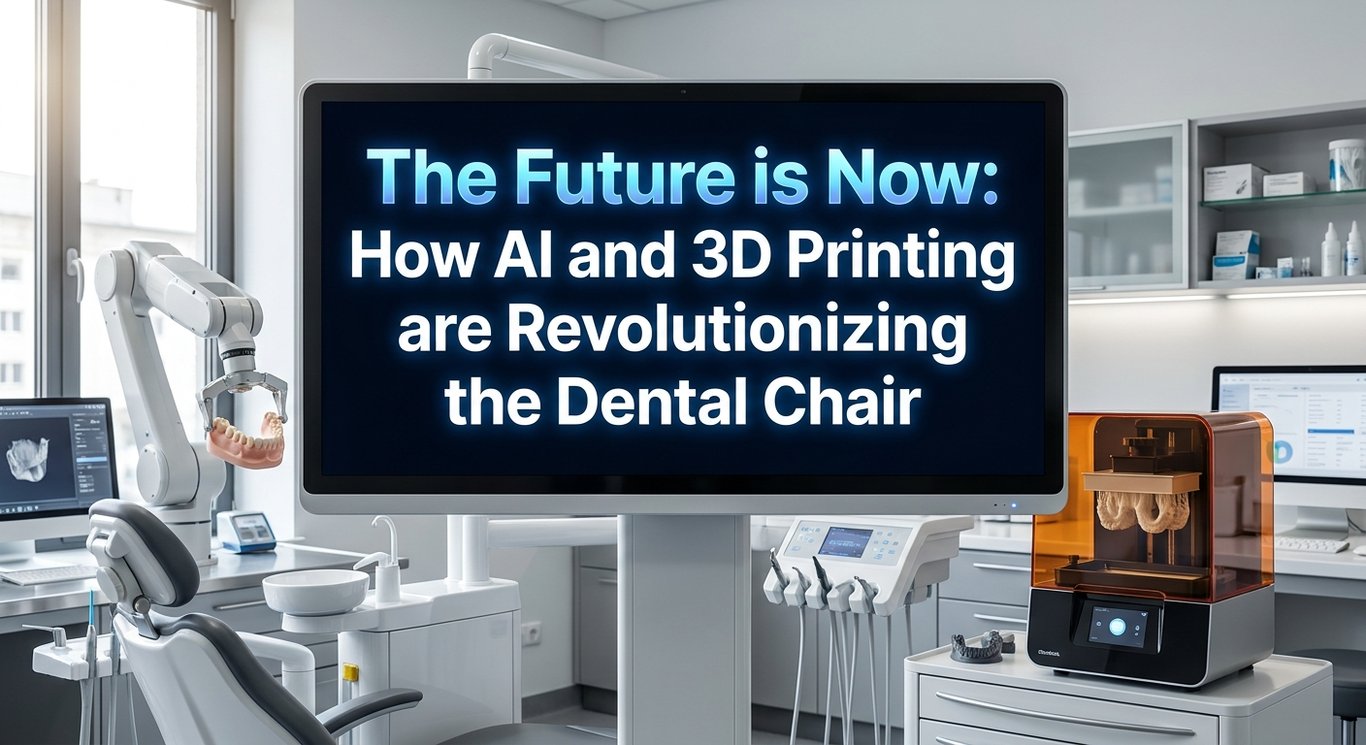
The dental chair itself is being reimagined as a result. It's no longer just a place where someone opens their mouth and hopes for the best — it's becoming a connected hub where digital tools, intelligent software, and precision manufacturing all come together in real time. Intraoral scanners feed data into AI-powered platforms, which then communicate with 3D printers to produce custom devices on demand. This kind of integration has captured serious attention from dental researchers, clinical reviewers, and professional organizations worldwide, all of whom are tracking the rapid transformation of digital dentistry with growing enthusiasm and a few important cautions.
What AI Does in Modern Dentistry
Artificial intelligence has found a natural home in dental diagnostics, and it's proving to be a genuinely useful partner for clinicians. AI algorithms can analyze X-rays and 3D imaging scans with impressive speed, flagging signs of caries, bone loss, periodontal disease, and other conditions that might be easy to miss during a routine visual exam. These systems are trained on enormous datasets of clinical images, which means they can recognize patterns that even experienced dentists might overlook. Beyond detection, AI also plays a role in treatment planning — helping clinicians map out procedures with greater precision, predict outcomes, and reduce the kind of human error that naturally creeps into complex, multi-step workflows. The overall effect is a more consistent, data-supported approach to care.
Beyond diagnostics, AI is also streamlining the operational side of dental practice. In digital workflows, AI tools can evaluate prosthetic designs, check for fit issues before fabrication begins, and flag inconsistencies in treatment plans. Some systems can even automate repetitive design decisions in CAD/CAM software, cutting down the time technicians spend on routine tasks. This kind of intelligent automation is spreading quickly through dental education as well, with dental schools beginning to incorporate AI literacy into their curricula. The broader trend is clear: AI isn't just a diagnostic tool anymore — it's becoming a core part of how modern dental practices think, plan, and operate.
How 3D Printing Is Changing Dental Treatments
Three-dimensional printing has moved well beyond novelty status in dentistry — it's now a practical, widely adopted technology that's changing how treatments are made and delivered. Dental labs and in-office setups are using 3D printers to produce crowns, bridges, clear aligners, full and partial dentures, surgical guides, study models, retainers, and custom appliances. Each of these items is built from a digital file created from a patient's own scan data, which means the final product is designed specifically for that person's anatomy. That level of patient-specific fabrication would have been extremely difficult to achieve at scale with traditional methods, but 3D printing makes it routine. Turnaround times that once stretched across weeks are now measured in hours.
The improvements go beyond just speed. Because 3D-printed dental devices are built layer by layer from precise digital blueprints, they tend to fit better and require fewer adjustments than conventionally manufactured alternatives. Patients spend less time in the chair waiting for remakes or modifications, and dentists can deliver more predictable outcomes across a wider range of procedures. Clinical reviews consistently describe 3D printing as one of the most significant drivers of precision and personalization in modern dentistry. As materials continue to improve and printer technology becomes more accessible, these advantages are only going to become more pronounced across the profession.
The Convergence of AI and 3D Printing in the Dental Chair
When AI and 3D printing work together inside a unified digital workflow, the results are genuinely impressive. The process typically begins with a digital scan — either an intraoral scan taken chairside or a cone beam CT image — which feeds into an AI-assisted design platform. That platform analyzes the patient's anatomy, suggests optimal restoration dimensions, checks for occlusal conflicts, and selects appropriate materials based on the clinical context. Once the design is finalized, it's sent directly to a 3D printer, which fabricates the physical device with minimal human intervention. The entire pipeline, from scan to finished product, can run with a level of speed and accuracy that traditional workflows simply can't match.
Leading dental publications have taken note of this combination, describing it as one of the most important innovation pathways in the field right now. The reason is straightforward: AI handles the intelligence layer — the analysis, optimization, and decision support — while 3D printing handles the physical output. Together, they create a system that is faster, more consistent, and far more scalable than anything built on manual labor alone. Importantly, this combination also supports highly individualized care, because every digital design can be tailored to a specific patient and then printed with precision. That balance of efficiency and personalization is exactly what modern dental practices are looking for.
Benefits for Dentists and Dental Practices
From a clinical and business standpoint, the practical benefits of these technologies are hard to ignore. Shorter appointment cycles mean patients spend less time in the chair and practices can see more people without sacrificing quality. Fewer remakes and adjustments reduce material waste and lab costs. Better-fitting restorations lead to higher patient satisfaction and fewer follow-up visits. In restorative and prosthodontic work especially, reducing variability is a major win — when every crown or denture is built from a precise digital file rather than an impression that can distort, the quality floor rises significantly. These aren't just theoretical advantages; they translate directly into a more efficient, more profitable, and more professionally satisfying practice.
Beyond the immediate clinical gains, AI and 3D printing also open doors to expanded access and improved case predictability over the long term. Practices in underserved areas, for example, can produce restorations in-house rather than relying on external labs, which reduces both cost and wait time for patients who may not have easy access to specialist care. Many authoritative sources in dental research highlight efficiency and cost-effectiveness as two of the most compelling reasons for broader adoption of these technologies. The bottom line is that practices willing to invest in digital infrastructure now are positioning themselves for a competitive advantage that will only grow as these tools become the standard of care.

Patient Experience and Personalization
For patients, the shift toward AI and 3D printing means something simple but meaningful: dental care that feels less like a chore and more like a service designed specifically for them. Same-day or next-day restorations eliminate the frustration of wearing a temporary crown for weeks. Better-fit aligners and appliances are more comfortable and more effective. AI-supported diagnostics mean problems are caught earlier and treatment plans are explained with more clarity and visual support. When patients can see a digital model of their own teeth on a screen and understand exactly what's being recommended and why, the whole experience feels more transparent and less intimidating. That shift in experience matters a great deal for patient trust and long-term retention.
Personalized dentistry is increasingly becoming a central theme in current dental research, and technology is the engine driving it forward. Rather than applying a one-size-fits-all approach to restorations or orthodontic treatment, clinicians can now design care plans and physical appliances that match each patient's unique anatomy, bite pattern, and clinical needs with remarkable precision. This isn't just about comfort — it's about outcomes. A restoration that fits perfectly from the start performs better over time. An aligner series designed with AI input moves teeth more predictably. The evidence base for personalized, technology-driven care is growing, and patients are beginning to expect it as the new normal.
Common Clinical Applications in 2026 and Beyond
In 2026, the list of real-world applications for AI and 3D printing in dentistry is long and still growing. Clear aligners are one of the most visible examples, with AI used to plan tooth movement sequences and 3D printing used to produce the aligner trays themselves. Crowns, bridges, and inlays are regularly fabricated chairside using CAD/CAM workflows supported by AI design tools. Full and partial dentures are printed with increasingly lifelike aesthetics and durable materials. Surgical guides for implant placement are among the most precise and clinically impactful applications, reducing surgical risk and improving implant positioning. Retainers, splints, night guards, and study models round out a toolkit that covers a huge portion of everyday dental practice. AI adds value at every stage — in imaging analysis, treatment planning, design validation, and quality control.
Looking further ahead, the applications become even more exciting, though some remain in earlier stages of development. Regenerative dentistry is exploring the use of bioactive materials that can stimulate tissue repair, and bioprinting — the printing of biological scaffolds using living cells — is being investigated as a potential pathway to growing dental tissues in the lab. Researchers are also working on smart materials that respond to temperature or pH changes in the mouth, offering dynamic performance rather than static function. These emerging areas are genuinely promising, but authoritative reviews are careful to note that they require significantly more clinical evidence, regulatory review, and long-term validation before they become part of routine practice. The direction is exciting; the timeline is still being written.
Challenges, Limits, and What Still Needs to Improve
Despite all the enthusiasm, it's important to be honest about where these technologies still fall short. Material science in 3D printing for dentistry has come a long way, but not all printable materials match the long-term durability and biocompatibility of traditional options like zirconia or metal alloys. Regulatory frameworks in many countries are still catching up with the pace of innovation, which creates uncertainty around which materials and workflows are approved for specific clinical uses. Perhaps most critically, the clinical evidence base — while growing — still lacks the long-term, large-scale randomized controlled trials that would give clinicians full confidence in adopting every new application. Research consistently emphasizes that broader adoption needs to be supported by rigorous validation, not just promising early results.
Implementation barriers are another significant challenge that practices can't afford to overlook. The upfront cost of digital scanners, AI software subscriptions, CAD/CAM systems, and 3D printers can be substantial, particularly for smaller practices. Training staff to use these systems effectively takes time and ongoing education, and integrating new digital workflows into an existing practice without disrupting patient care requires careful planning. There's also the challenge of interdisciplinary collaboration — getting dentists, lab technicians, software vendors, and material suppliers all working from the same playbook isn't always straightforward. These issues appear repeatedly in major reviews of digital dentistry, and they serve as a useful reminder that technology adoption is as much a human and organizational challenge as it is a technical one.

How Dental Offices Can Prepare for Adoption
For practices ready to move toward digital dentistry, the good news is that the path forward doesn't have to be overwhelming. A thoughtful starting point is to evaluate the core components of a digital workflow: intraoral scanners, CAD/CAM design software, AI diagnostic tools, and entry-level 3D printers. Not every practice needs to adopt all of these at once — in fact, starting with one or two well-chosen tools and building from there is often the smarter approach. Staff training is just as important as equipment selection; a high-end scanner sitting unused because nobody knows how to use it properly is a waste of money. Workflow planning — mapping out exactly how digital tools will fit into existing appointment structures — should happen before any major purchases are made.
Once the basics are in place, practices can expand strategically by starting with high-value, lower-complexity applications. Printing study models, surgical guides, and simple single-unit restorations are excellent entry points because they deliver immediate clinical value without requiring the most advanced equipment or the steepest learning curve. From there, practices can move into more complex applications like full-arch dentures or multi-unit bridges as their team builds confidence and competence. Throughout this process, quality control is non-negotiable — every printed device should be checked against defined standards before it reaches a patient. Vendor selection also matters enormously; partnering with suppliers who offer strong technical support, training resources, and a track record of regulatory compliance will make the adoption journey significantly smoother.
Future Trends Shaping the Next Generation of Dental Chairs
The next generation of dental technology is already coming into focus, and it's a fascinating picture. AI-assisted treatment planning is becoming more sophisticated, with systems that can model entire treatment sequences and predict outcomes based on patient-specific data. Virtual and augmented reality are being explored as tools for patient education, surgical training, and even chairside visualization of planned procedures. Four-dimensional printing — which produces objects that can change shape or function over time in response to environmental stimuli — is an emerging concept with potential applications in orthodontics and tissue regeneration. Smart biomaterials that interact with the biological environment of the mouth are another active area of research. And the integration between scanning, design, and fabrication is becoming tighter, faster, and more automated with each passing year. These trends are widely discussed in current authoritative literature as the leading edge of where the field is heading.
The dental chair of the future will likely be a very different environment from what most patients experience today. It may be equipped with sensors that monitor oral health in real time, feeding data to AI systems that track changes between visits and flag emerging issues before they become serious problems. Same-visit comprehensive care — where a patient comes in, gets scanned, has their treatment planned, and leaves with a finished restoration or appliance — will become increasingly common rather than exceptional. The long-term direction of the field is unmistakably toward more automated, more personalized, and more data-driven dentistry. What's remarkable is that this future isn't decades away — much of it is already happening in forward-thinking practices around the world.
Frequently Asked Questions
FAQ 1: How are AI and 3D printing used together in dentistry?
AI and 3D printing work as complementary parts of a connected digital workflow. AI handles the analytical and design side — it processes scan data, identifies clinical needs, plans treatments, and optimizes the design of restorations or appliances for fit and function. Once that design is finalized and validated, it's sent to a 3D printer, which fabricates the physical object with precision based on the patient's own anatomy. The combination means that every step from diagnosis to delivery is guided by data and executed with accuracy, reducing the reliance on manual labor and the variability that comes with it.
FAQ 2: What dental procedures benefit most from 3D printing?
Some of the most well-established clinical applications of 3D printing in dentistry include clear aligners, crowns, bridges, full and partial dentures, surgical guides for implant placement, retainers, night guards, and diagnostic study models. These applications are widely used in both dental labs and in-office setups, and they represent areas where 3D printing has clearly demonstrated advantages in terms of fit, speed, and customization. Among these, surgical guides and aligners are particularly notable for the precision they require and the degree to which 3D printing delivers on that requirement.
FAQ 3: Will AI replace dentists or dental technicians?
The current evidence strongly suggests that AI is a support tool, not a replacement for clinical expertise. AI systems are very good at processing large amounts of data quickly and consistently, which makes them valuable for tasks like image analysis, pattern recognition, and design optimization. But they lack the clinical judgment, patient communication skills, and hands-on dexterity that dentists and dental technicians bring to their work every day. The most accurate way to think about AI in dentistry is as a highly capable assistant — one that helps professionals do their jobs better, faster, and with fewer errors, rather than one that makes their roles obsolete.
FAQ 4: Is 3D printing in dentistry safe and reliable?
Safety and reliability in dental 3D printing depend on several important factors working together correctly. The materials used must be validated for clinical use and meet regulatory standards for biocompatibility. The workflow — from scanning to design to printing to finishing — must follow established protocols to ensure consistent quality. And the clinical evidence supporting specific applications must be sufficient to justify their use in patient care. When all of these conditions are met, 3D printing is considered safe and reliable for many dental applications. However, long-term clinical studies are still needed for some newer uses, and practitioners should stay informed about regulatory requirements in their region.
FAQ 5: What is the future of AI and 3D printing in the dental chair?
The future of AI and 3D printing in dentistry points clearly toward more personalized, automated, and efficient care. Digital workflows will become faster and more integrated, with AI systems handling more of the planning and optimization work while 3D printers produce a wider range of devices with improved materials. Emerging areas like bioprinting, smart biomaterials, and AI-driven monitoring will gradually move from research settings into clinical practice as the evidence base matures. For patients, this means care that is more tailored to their individual needs and delivered more quickly. For practices, it means a more competitive, capable, and future-ready operation built on a foundation of intelligent technology.
Conclusion
The transformation happening in dentistry right now is real, significant, and accelerating. AI is improving how dentists diagnose conditions, plan treatments, and manage their workflows — bringing greater accuracy and consistency to every stage of care. Three-dimensional printing is enabling the fabrication of highly customized dental devices with a speed and precision that traditional methods can't match. Together, these technologies are not just improving individual procedures — they are fundamentally reshaping what it means to deliver dental care in the modern era. The dental chair is evolving from a single piece of furniture into the centerpiece of a connected, intelligent, patient-focused system.
If you're a dental professional, practice owner, or someone who simply wants the best possible care, the message is clear: the future of dentistry is already here, and engaging with it is no longer optional — it's strategic. Embracing The Future is Now: How AI and 3D Printing are Revolutionizing the Dental Chair means investing in better patient outcomes, stronger practice performance, and long-term relevance in a rapidly changing field. The practices that start building digital capabilities today will be the ones setting the standard tomorrow. The next era of dentistry isn't coming — it's already taking shape in clinics around the world, one scan, one design, and one perfectly fitted restoration at a time.