The Future in the Chair: A Patient's Guide to Emerging Dental Technologies
Published 17 min read
Introduction to the New Era of Dental Care
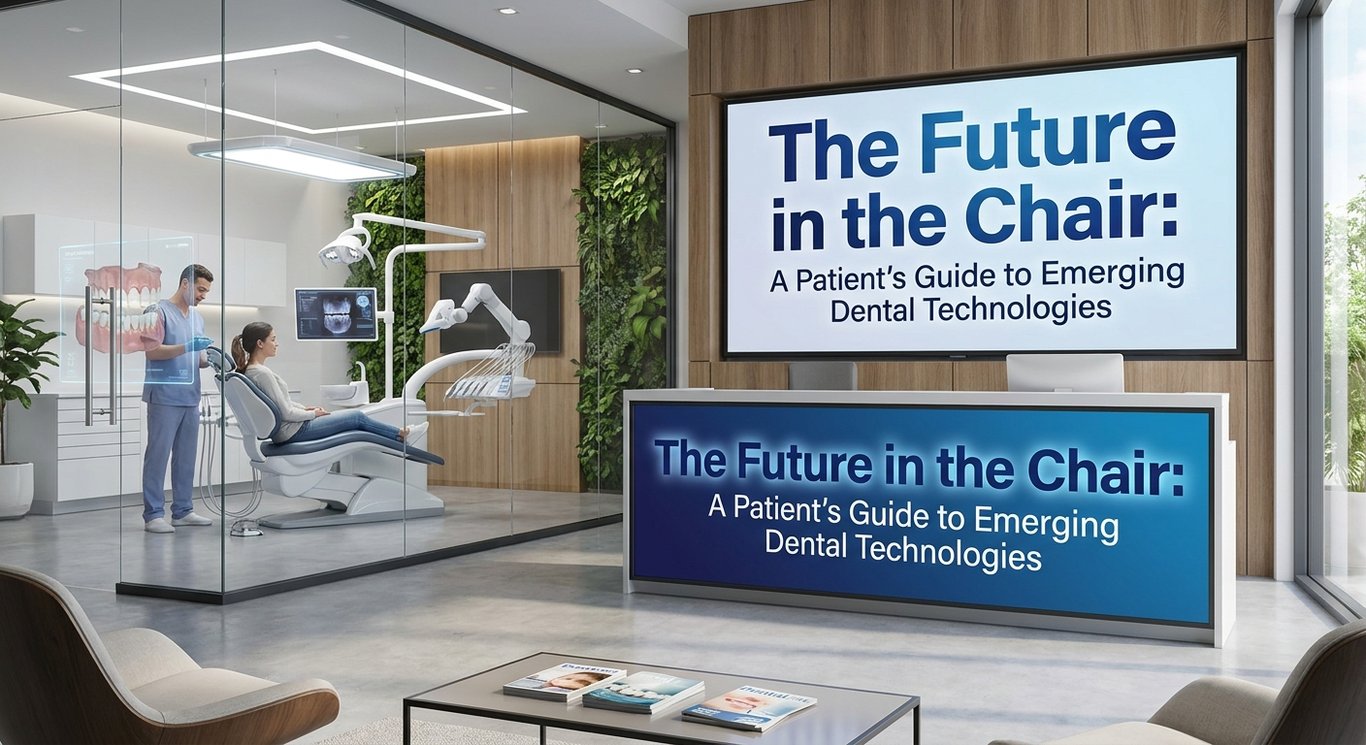
Emerging dental technologies are tools, systems, and techniques that have been developed or widely adopted in recent years to improve how dentists diagnose, plan, and deliver care. For patients, this means visits that are faster, more comfortable, and more precise than what was possible even a decade ago. This topic matters right now because these technologies are no longer limited to research labs or elite specialty practices — they are showing up in general dental offices across the country, and understanding them helps patients make smarter decisions about their own care.
Throughout this guide, we will walk through the most important innovations changing dentistry today. That includes AI-powered diagnostics, digital X-rays and 3D imaging, intraoral scanners, CAD/CAM same-day restorations, 3D printing, laser dentistry, and teledentistry. Each of these plays a different role in the patient experience, and by the end of this article, you will have a clear picture of what to expect, what to ask, and why any of it should matter to you the next time you sit down in that chair.
What Patients Mean by "Dental Technology" Today
Not long ago, a dental visit meant biting down on a tray full of gooey impression material, waiting weeks for a lab to send back a crown, and relying on two-dimensional X-rays to catch problems that might be hiding in plain sight. That version of dentistry is quickly becoming the exception rather than the rule. The shift happening now is a move from analog, manual processes to fully digital workflows — where data is captured, processed, and acted on with far greater speed and accuracy than traditional methods allowed.
Modern dental systems improve the patient experience in four key ways: precision, comfort, speed, and communication. Digital tools reduce human error in measurements and fit. Scanners and lasers make many procedures less physically uncomfortable. Same-day technology means fewer appointments and less time off work. And better imaging tools help dentists explain exactly what is happening in your mouth, so you leave the office actually understanding your treatment plan rather than just nodding along. Together, these improvements represent a meaningful change in what patients can reasonably expect from a visit to the dentist.
Digital X-Rays, 3D Imaging, and CBCT Scans
Traditional X-rays give dentists a flat, two-dimensional snapshot of your teeth. Digital X-rays improve on that by producing clearer images instantly and with less radiation. But the real leap forward comes with cone beam computed tomography, commonly called CBCT. This technology creates a three-dimensional image of your teeth, roots, jawbone, nerves, and surrounding anatomy all at once. That level of detail allows dentists to see things that simply were not visible before — the exact position of an impacted wisdom tooth, the depth of a bone defect around an implant, or the precise path of a nerve before surgery.
One of the most common questions patients have about these scans is whether they are safe. The short answer is yes, especially compared to older film-based X-rays. Digital X-rays use significantly less radiation than traditional ones, and CBCT scans, while slightly higher in radiation than standard digital X-rays, are used selectively for cases where the 3D detail is clinically necessary. Dentists typically use CBCT imaging before implant placement, complex extractions, orthodontic planning, or when evaluating jaw conditions. The improved diagnostic accuracy they provide means fewer surprises during treatment and better outcomes overall.
Intraoral Scanners and Digital Impressions
If you have ever gagged on a tray of impression material while your dentist counted down the seconds, you already understand why intraoral scanners are a welcome development. These handheld wand-like devices are moved around the inside of your mouth to capture thousands of images per second, which are then stitched together into a precise 3D digital model. The whole process takes just a few minutes, produces no mess, and gives the dentist or lab an accurate representation of your teeth and bite that can be used immediately in treatment planning or sent digitally to a lab.
Patients often wonder whether digital impressions are as accurate as the old-fashioned kind. Research and clinical experience consistently show that they are — and in many cases, more so, because digital models eliminate the distortion that can occur when impression material shifts or sets unevenly. These scans are now routinely used for crowns, veneers, bridges, dental implants, and clear aligner therapy. The comfort factor is also significant: patients with strong gag reflexes or dental anxiety often find the scanner much easier to tolerate than traditional impressions, which makes the whole appointment less stressful from start to finish.
CAD/CAM Dentistry and Same-Day Restorations
CAD/CAM stands for computer-aided design and computer-aided manufacturing, and it has fundamentally changed how dental restorations are made. Once a digital scan of your tooth is taken, specialized software is used to design the restoration — a crown, veneer, inlay, onlay, or bridge — on screen with precise measurements. That design is then sent to an in-office milling machine that carves the restoration out of a ceramic block in a matter of minutes. The result is a custom-fitted restoration made entirely in the dental office, often within a single appointment.
The most common question patients ask about same-day dentistry is whether a crown made in an hour can possibly be as good as one made in a lab over two weeks. The answer, backed by years of clinical data, is that CAD/CAM restorations are highly durable, well-fitting, and aesthetically strong when placed by a trained dentist using quality materials. The obvious patient benefit is convenience — no temporary crown, no second appointment, no waiting. For people with busy schedules or dental anxiety, completing a restoration in one visit rather than two or three is a significant quality-of-life improvement that goes beyond just the clinical result.
3D Printing in Dentistry
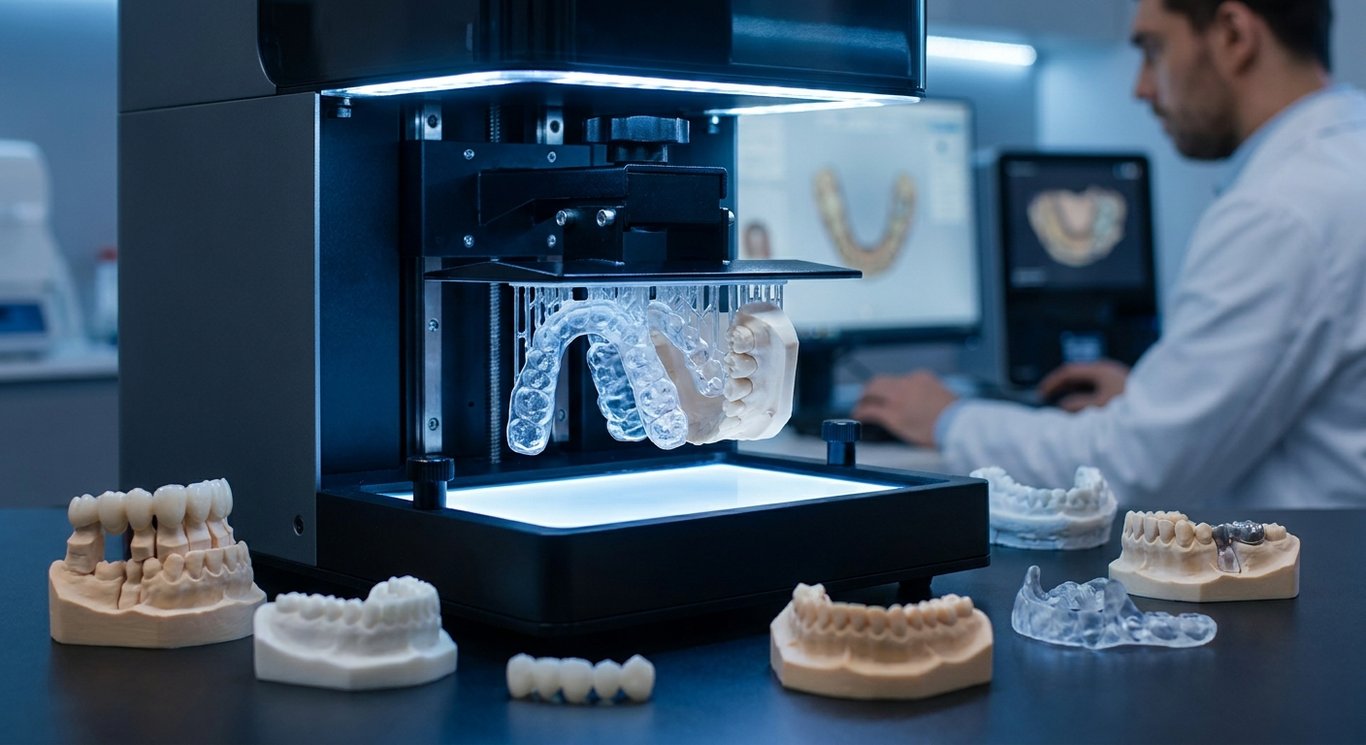
Three-dimensional printing has moved from a novelty to a genuinely useful clinical tool in dentistry over the past several years. In a dental context, 3D printers are used to create surgical guides that help dentists place implants with pinpoint accuracy, custom dentures and partials, orthodontic models, clear aligner trays, night guards, and other appliances. The process starts with a digital file — often generated from a scan — and the printer builds the object layer by layer from dental-grade resin or other materials. What used to require multiple lab steps and days of waiting can now be produced in hours.
Authoritative dental organizations and publications consistently highlight 3D printing for three reasons: speed, customization, and treatment planning accuracy. Because every printed device is built from a precise digital model of the patient's own anatomy, the fit tends to be better than devices made from manual impressions. Surgical guides, in particular, improve implant placement outcomes by reducing the margin for error. For patients, this translates to shorter procedures, fewer adjustments, and devices that actually fit properly from the start — which is a bigger deal than it might sound if you have ever dealt with an ill-fitting denture or a retainer that needed endless tweaking.
AI and Machine Learning in Diagnosis and Treatment Planning
Artificial intelligence is making its way into dental diagnosis in a meaningful way. AI-powered software can analyze digital X-rays and 3D scans to flag potential cavities, bone loss, root issues, and other problems that might be easy to overlook on a quick visual review. These systems are trained on enormous datasets of dental images, which allows them to identify patterns and anomalies with a level of consistency that complements what a dentist sees. Beyond detection, AI tools can also assist with treatment planning by analyzing patient data and suggesting evidence-based approaches tailored to individual cases.
That said, it is important to understand what AI does and does not do in a dental setting. It is a support tool, not a replacement for clinical judgment. A dentist still reviews every flagged finding, interprets it in the context of the patient's full history, and makes the final call on diagnosis and treatment. Patients sometimes worry that AI means less human involvement in their care, but the reality is the opposite — it gives dentists better information so they can make more thoughtful decisions. Think of it less like handing your care over to a machine and more like giving your dentist a very thorough second opinion built into the system.
Laser Dentistry and Minimally Invasive Treatment
Lasers have been used in dentistry for decades, but the technology has become significantly more refined and widely available in recent years. Dental lasers are used for a range of soft tissue procedures including gum reshaping, treating gum disease, removing overgrown tissue, and managing canker sores. They are also used in some cavity removal procedures, teeth whitening, and frenectomies. The laser works by delivering concentrated light energy to tissue, which cuts, vaporizes, or disinfects with much greater precision than a scalpel or drill — and often with less trauma to the surrounding area.
The questions patients most commonly ask about laser dentistry center on pain, bleeding, and healing. In general, laser procedures involve less bleeding than traditional surgery because the laser seals blood vessels as it works. Many soft tissue procedures can be performed with little to no anesthesia, and healing time is often faster because the surrounding tissue sustains less damage. Not every procedure is a candidate for laser treatment — it depends on the specific condition, the type of laser the dentist has, and the clinical situation. But for patients who have been putting off treatment because they dread the drill or the scalpel, laser options are worth asking about.
Teledentistry and Remote Dental Access
Teledentistry uses video calls, secure messaging, and digital image sharing to connect patients with dental professionals without requiring an in-person visit. This can mean a video consultation to discuss symptoms before deciding whether to come in, a follow-up check after a procedure to make sure healing is progressing normally, or a remote triage appointment to determine the urgency of a dental concern. For patients in rural areas, those with mobility limitations, or people managing busy schedules, teledentistry offers a level of access and convenience that simply was not possible before.
It is worth being clear about what teledentistry can and cannot do. Remote visits are well-suited for consultations, follow-ups, prescription renewals for established patients, and determining whether a problem needs urgent in-person care. They are not a substitute for a full examination, X-rays, or any hands-on treatment. A dentist cannot fill a cavity, place an implant, or take a scan over video. The value of teledentistry lies in improving the flow of care around those in-person visits — making it easier to get advice quickly, avoid unnecessary trips, and stay connected with your dental provider between appointments.
Patient Education Tools: Intraoral Cameras, AR, and VR
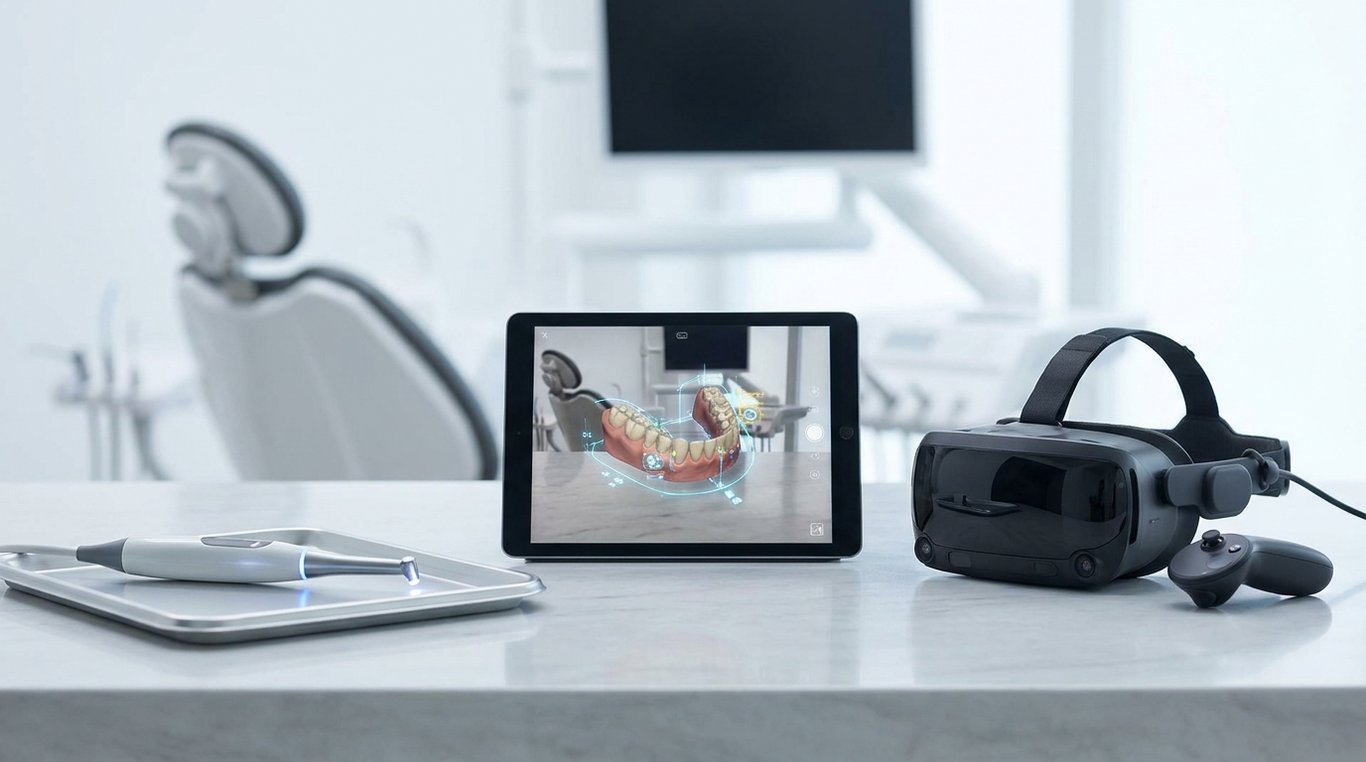
One of the most underappreciated technologies in modern dentistry is the intraoral camera — a small, pen-sized device that captures high-definition video and images from inside the mouth and displays them on a screen in real time. When a dentist can show you exactly what they are seeing, rather than just describing it, patient understanding improves dramatically. You can see the crack in the tooth, the inflamed gum tissue, or the early decay that the dentist is concerned about. That visual connection builds trust and makes it much easier to say yes to a recommended treatment when you can see the problem yourself.
Beyond intraoral cameras, augmented reality and virtual reality are beginning to find their place in dental education and patient care. AR applications can overlay digital information onto real-world views, helping patients visualize what a proposed treatment — like veneers or orthodontic movement — might look like before committing to it. VR is being explored as a tool to reduce dental anxiety by immersing patients in calming environments during procedures. While these applications are still emerging and not yet standard in most practices, they represent an exciting direction for making dental care less intimidating and more transparent for patients who have historically struggled with dental fear.
How New Technology Improves Comfort, Speed, and Outcomes
When you look across all the technologies covered in this guide, a consistent set of patient benefits emerges. Authoritative dental sources — from professional associations to peer-reviewed research — repeatedly emphasize the same core improvements: less invasive procedures, faster healing, better diagnostic precision, and greater convenience. These are not small quality-of-life upgrades. For a patient who has avoided the dentist for years because of anxiety or discomfort, a practice that uses lasers instead of drills, scanners instead of impression trays, and digital imaging instead of guesswork can genuinely change the relationship with dental care.
Beyond individual comfort, these technologies work together to reduce the total burden of dental treatment over time. Better diagnostics catch problems earlier, when they are smaller and less expensive to treat. Better-fitting restorations need fewer adjustments and last longer. Same-day procedures eliminate multiple appointments. AI-assisted planning reduces the chance of surprises mid-treatment. The cumulative effect is dental care that is more individualized, more efficient, and more likely to produce results that hold up over the long term — which is ultimately what every patient is hoping for when they sit down in that chair.
What Patients Should Ask Before Choosing a Tech-Forward Dental Practice
Not all dental practices that advertise "advanced technology" are using it in ways that will actually benefit you. Before choosing a practice based on its equipment, it helps to ask the right questions. Some of the most useful ones include: Which specific technologies do you use, and for what procedures? How does this technology improve outcomes for my particular situation? Will using this technology change the cost of my treatment, and is it covered by my insurance? How long have you been using this system, and what training have you completed? These questions shift the conversation from marketing language to clinical substance.
Evaluating a tech-forward dental practice also means looking at the people behind the tools. Technology is only as good as the practitioner using it. Ask about the dentist's continuing education in the specific systems they use, whether they can explain clearly why a particular technology is the right choice for your case, and whether they are transparent about both the benefits and the limitations. A dentist who is genuinely using technology to improve patient care will welcome these questions. One who gets evasive or pivots back to selling you on the equipment itself is worth approaching with more caution. The best dental technology is the kind that serves your health — not the kind that just looks impressive on a website.
Frequently Asked Questions
Are digital X-rays safer than traditional X-rays?
Yes, digital X-rays expose patients to significantly less radiation than traditional film-based X-rays — typically around 70 to 80 percent less, depending on the system used. While any X-ray involves some level of radiation, the doses involved in modern digital dental imaging are extremely low and considered safe for routine diagnostic use. CBCT scans involve a bit more radiation than standard digital X-rays, but they are used selectively when the three-dimensional detail they provide is clinically necessary — such as before implant placement or complex oral surgery. The diagnostic benefit in those cases far outweighs the minimal risk. Dentists also follow the ALARA principle — As Low As Reasonably Achievable — meaning they only take X-rays when there is a clear clinical reason to do so.
Do digital impressions really replace messy molds?
In most cases, yes. Intraoral scanners have replaced traditional impression trays for a wide range of procedures in practices that have adopted the technology. The scanner captures a detailed 3D digital model of your teeth and bite without any impression material, trays, or waiting for material to set. For patients who struggle with the gag reflex or find traditional impressions uncomfortable, this is a significant improvement. The digital models are accurate enough to be used for crowns, bridges, veneers, implant restorations, and clear aligner therapy. There are some clinical situations — particularly involving very deep subgingival margins — where a traditional impression may still be preferred, but for the majority of everyday restorative and orthodontic cases, digital impressions are both practical and precise.
Is same-day dentistry as durable as traditional restorations?
Research and long-term clinical data consistently show that CAD/CAM restorations — the kind made in-office in a single visit — perform comparably to lab-fabricated restorations in terms of durability, fit, and longevity when placed correctly. The ceramic materials used in most in-office milling systems are high-quality and designed to withstand normal biting forces. That said, outcomes depend on several factors: the skill and experience of the dentist using the system, the quality of the digital scan, the specific material chosen, and how well the patient cares for the restoration afterward. Same-day dentistry is not a shortcut — it is a different workflow that, when executed well, produces results that hold up over time. If you are considering a same-day crown, asking your dentist about their experience with the system and the materials they use is a reasonable and worthwhile question.
Can teledentistry replace an in-person dental visit?
Teledentistry cannot replace an in-person visit for diagnosis, treatment, or any hands-on care — and it is not designed to. What it can do is make the care around those visits more efficient and accessible. A remote consultation can help you decide whether a toothache needs urgent attention or can wait for a scheduled appointment. A video follow-up after a procedure can confirm that healing is going well without requiring you to take time off work. For patients in underserved areas or with limited mobility, teledentistry can provide access to professional guidance that might otherwise be difficult to get. Think of it as a valuable complement to in-person care, not a substitute for it. Any significant dental concern — pain, swelling, bleeding, suspected infection — still requires an in-person evaluation and treatment.
Which emerging dental technology is most useful for patients right now?
That depends on your specific dental needs, but if one technology stands out for its broad impact across nearly every type of patient, it is digital imaging — including digital X-rays and CBCT scans. Better imaging directly improves diagnosis, which is the foundation of all good dental care. Catching a problem earlier, seeing it more clearly, and planning treatment more accurately benefits patients regardless of what kind of work they need done. Close behind that, intraoral scanners and CAD/CAM technology have made a meaningful difference in everyday restorative dentistry by improving comfort and reducing the number of appointments required. For patients undergoing implant placement, orthodontic treatment, or more complex procedures, 3D printing and AI-assisted planning are also delivering real, measurable improvements. The honest answer is that these technologies work best together — each one addresses a different part of the patient experience.
Conclusion: What the Future in the Chair Means for Patients
The technologies covered in this guide — digital imaging, intraoral scanners, CAD/CAM restorations, 3D printing, artificial intelligence, laser dentistry, and teledentistry — are not distant promises. They are tools that are actively being used in dental practices today to make care more precise, more comfortable, and more accessible than it has ever been. Each one addresses a real pain point in the patient experience, whether that is the discomfort of traditional impressions, the inconvenience of multiple appointments, the anxiety of not understanding what is happening in your mouth, or the challenge of getting care at all. Together, they represent a genuine shift in what modern dentistry can offer.
Use this guide — "The Future in the Chair: A Patient's Guide to Emerging Dental Technologies" — as a starting point for a more informed conversation with your dentist. Bring it to your next appointment as a kind of checklist. Ask which of these technologies your practice uses, why, and how they might apply to your specific situation. The best dental care has always been a partnership between patient and provider, and understanding the tools available puts you in a much stronger position to be an active participant in your own oral health. The future of dentistry is already here — you just have to ask the right questions to take advantage of it.