The Biomimetic Revolution: How Dentists Are Rebuilding Teeth to Mimic Nature
Published 21 min read
For decades, dentistry operated on a fairly straightforward philosophy: when a tooth breaks down, you replace what's lost with something artificial. That approach worked, but it came with a significant trade-off — the more a tooth was drilled, capped, or treated, the less natural tooth structure remained. Biomimetic dentistry flips that script entirely. At its core, biomimetic dentistry is the art and science of restoring damaged teeth using techniques and materials that closely replicate the natural structure, biomechanics, and appearance of real teeth. Instead of defaulting to aggressive restorations, biomimetic dentists work to preserve what's already there, rebuilding teeth in a way that respects how nature originally designed them.
This shift represents a genuine revolution in how dental professionals think about restoration and long-term oral health. Across clinics and research institutions, there is growing excitement about what becomes possible when dentistry works with biology rather than against it. In this article, you'll learn exactly how biomimetic dentistry works, why it's gaining traction over conventional methods, which procedures fall under its umbrella, what the science says, who makes a good candidate, and what a biomimetic dental visit actually looks like. Whether you're facing a cracked tooth, an aging filling, or just want to make smarter long-term choices for your smile, this guide has you covered.
What Is Biomimetic Dentistry? Defining a Nature-Inspired Approach
The word "biomimetic" comes from two Greek roots: bios, meaning life, and mimesis, meaning imitation. Put them together and you get the central philosophy of this field — imitating life. In dentistry, that means restoring damaged teeth with materials and techniques that mimic the properties of natural enamel, dentin, and the dentin-enamel junction (DEJ), which is the critical interface between those two tissue layers. Rather than treating a tooth as something to be drilled down and capped, biomimetic dentistry treats it as a complex biological structure worth preserving and replicating as faithfully as possible.
What really sets biomimetic dentistry apart from conventional restorative dentistry isn't just the materials — it's the guiding principles behind every decision. Traditional dentistry often relies on mechanical retention, meaning the restoration is held in place by the shape of the cavity preparation. Biomimetic dentistry, by contrast, emphasizes maximal adhesion and preservation of intact tooth structure, aiming to replicate the natural biomechanics of how a tooth flexes, distributes force, and resists fracture. Importantly, this approach isn't limited to fillings and crowns. It extends across restorative and esthetic disciplines, influencing everything from how cavities are prepared to how veneers are placed.
The core goals of biomimetic dentistry can be summarized in four key ideas: conserve healthy tissue, maintain pulp vitality, seal out bacteria, and create restorations that look, feel, and function like natural teeth for as long as possible. These aren't just lofty ideals — they translate into concrete clinical decisions made at every step of treatment. When a biomimetic dentist picks up a drill, the guiding question isn't "how do I make room for a restoration?" but rather "how little do I need to remove to achieve an excellent result?"
Why Traditional Dentistry Needed a Revolution
Traditional restorative dentistry has saved countless teeth and improved millions of lives, and that deserves genuine credit. But it also has some well-documented limitations. Conventional crown preparation, for instance, often requires removing a significant amount of healthy tooth structure — sometimes 60 to 75 percent of the outer tooth — simply to create the mechanical shape needed to hold the crown in place. This sets off what many clinicians call a "dental death spiral": a large filling eventually fails, gets replaced by a crown, which later requires a root canal, which may ultimately end in extraction. Each step is more invasive than the last.
Beyond the structural sacrifice, conventional materials and techniques don't always replicate the natural flexibility and stress distribution found in real teeth. Natural enamel and dentin work together as a system, with the softer dentin absorbing shock and the harder enamel providing a protective outer shell. When that system is disrupted by large metal fillings or rigid crowns that don't flex naturally, the remaining tooth structure can be placed under abnormal stress. Over time, this can contribute to cracks, sensitivity, and secondary decay forming around the edges of restorations. These aren't failures of dentistry — they're limitations of materials and approaches that weren't designed with biomechanics as the primary concern.
Biomimetic principles emerged specifically to address these recurring problems. By focusing on minimally invasive preparation, strong adhesive bonding, and materials that behave more like natural tooth tissues, biomimetic dentistry aims to break the cycle of overtreatment. The goal is not just to fix today's problem but to leave the tooth in a better position for the next decade and beyond. That long-term thinking is what makes this approach feel genuinely revolutionary rather than just a minor technical upgrade.
How Dentists Mimic Nature: Core Principles and Techniques
The foundation of biomimetic dentistry starts with a deceptively simple principle: don't remove what you don't have to. Dentists practicing this approach preserve intact enamel and dentin wherever possible, removing only the tissue that is genuinely damaged or decayed. This conservative mindset matters enormously for long-term outcomes. Healthy tooth structure is irreplaceable, and every millimeter preserved contributes to the tooth's overall strength, flexibility, and ability to protect the pulp — the living nerve tissue at the center of the tooth.
Advanced adhesive dentistry is another cornerstone of the biomimetic approach. Modern bonding systems have improved dramatically over the past two decades, and biomimetic dentistry makes full use of that progress. High-quality adhesives create strong, durable seals between restorative materials and natural tooth tissues, dramatically reducing microleakage — the microscopic gaps where bacteria can sneak in and cause secondary decay. Because the restoration is held in place by adhesion rather than mechanical shape alone, there's no need to grind away extra tooth structure just to make the cavity "retentive." The bond does the work, and the tooth keeps more of itself.
One of the more fascinating aspects of biomimetic technique is the layering and sculpting process used to rebuild the tooth. Natural teeth aren't uniform — they have a flexible, shock-absorbing inner layer of dentin covered by a harder, more wear-resistant outer layer of enamel. Biomimetic restorations replicate this gradient by using different composite or ceramic materials in specific layers. Softer, more elastic materials go down first to mimic dentin, followed by harder materials on top to replicate enamel. This layered architecture helps distribute chewing forces in a way that closely resembles what a natural tooth does, reducing the risk of fracture and improving long-term comfort.
Beyond layering, biomimetic dentistry also incorporates stress-reducing cavity designs, the use of onlays instead of full crowns whenever possible, and careful selection of materials matched to the mechanical properties of specific tooth tissues. For example, rather than covering an entire tooth with a crown when only one cusp is damaged, a biomimetic dentist might place a precisely bonded onlay that reinforces that specific area. These targeted, thoughtful strategies all share the same underlying logic: create a restoration that behaves like a real tooth under the demands of everyday life.
Biomimetic Materials: Enamel- and Dentin-Mimicking Innovations
The materials used in biomimetic dentistry are central to its success. Biomimetic dental materials are specifically designed — or strategically selected — to simulate the strength, elasticity, optical properties, and appearance of natural enamel and dentin. Advanced composite resins and high-strength ceramics are the most commonly used options, chosen not just for their looks but for how they perform under the mechanical demands of biting and chewing. The right material in the right place makes all the difference between a restoration that lasts and one that eventually fails.
The way these materials are layered is just as important as the materials themselves. Biomimetic dentists carefully recreate the tooth's natural gradient — placing more flexible, dentin-like composites in the deeper portions of the restoration and harder, enamel-like materials toward the surface. This gradient isn't just cosmetic. It plays a critical functional role by reducing stress concentrations that can lead to fractures. When a restoration flexes and responds to chewing forces the way natural tooth structure would, the tooth and the restoration work together rather than fighting each other.
Looking ahead, the field is moving toward something even more exciting: bioactive and regenerative materials that don't just fill a space but actively participate in the tooth's biology. Researchers are exploring materials that can release fluoride or calcium to encourage remineralization, promote the formation of secondary dentin, or even interact with the surrounding tissue to strengthen the tooth over time. These developments are still evolving, but they point toward a future where dental restorations don't just replace what was lost — they help rebuild it.
Common Biomimetic Procedures: From Fillings to Onlays
When it comes to everyday cavities, biomimetic fillings look quite different from conventional ones. The process begins with conservative removal of only the decayed tissue, leaving as much healthy enamel and dentin intact as possible. From there, a meticulous bonding protocol is applied to create a strong seal with the remaining tooth structure. Then comes the layering process — incrementally building up the restoration in anatomically accurate layers to replicate the natural shape and function of the tooth. The result is a filling that doesn't just plug a hole but actually restores the tooth's structural integrity.
For more significantly damaged teeth, biomimetic dentistry often turns to partial coverage restorations like onlays and overlays. These are custom-made pieces that cover and reinforce specific damaged areas — like a broken cusp or a worn biting surface — without requiring the dentist to grind down the entire tooth. Compared to a traditional full crown, an onlay preserves dramatically more healthy tooth structure while still providing excellent strength and protection. For many patients, this is a game-changer: they get the durability they need without the sacrifice they were told was unavoidable.
One of the more nuanced applications of biomimetic principles involves teeth that are close to needing a root canal but haven't quite crossed that line yet. In these situations, biomimetic strategies focus on protecting the pulp through careful, conservative preparation that avoids unnecessary heat or trauma, combined with strong sealing to block bacteria from reaching the nerve. By managing the biological environment around the pulp, biomimetic dentists can sometimes halt the progression of damage and preserve the tooth's vitality — sparing the patient an endodontic procedure that might otherwise have been considered inevitable.
Biomimetic techniques also integrate beautifully with esthetic dentistry. Because the layering and sculpting process is inherently artistic and detail-oriented, the restorations produced tend to be exceptionally lifelike. Color, translucency, surface texture — all of these can be replicated with a high degree of accuracy using modern composite and ceramic materials. The result is a restoration that doesn't just feel right but looks right too, blending seamlessly with the surrounding natural teeth.

Benefits for Patients: Longevity, Comfort, and Preserved Tooth Structure
The benefits of biomimetic dentistry for patients are both immediate and long-term. Most significantly, this approach preserves far more natural tooth structure than conventional methods, which matters enormously over the course of a lifetime. Less tooth removal means a stronger foundation for the restoration, better protection for the pulp, and a reduced likelihood of needing more invasive treatments down the road. For patients who want to keep their natural teeth for as long as possible — which, frankly, should be everyone — biomimetic dentistry offers a compelling path forward.
Patients also frequently report improved comfort following biomimetic restorations. Better sealing means less bacterial infiltration and less post-treatment sensitivity. The natural stress distribution achieved through layered materials means the tooth doesn't feel "off" under biting pressure. And because the restorations are designed to look like natural teeth — not just function like them — the esthetic outcomes tend to be excellent. Patients leave the chair with restorations that match their surrounding teeth in color and translucency, without the artificial or opaque appearance that older materials sometimes produced.
From a broader health and economic perspective, the long-term value of biomimetic dentistry is hard to overstate. Fewer retreatments mean fewer dental appointments, lower cumulative costs, and less time in the chair over a lifetime. Preserving natural teeth avoids the need for implants or dentures, which are more expensive and require more complex procedures. Leading clinicians and researchers consistently emphasize that keeping natural teeth healthy and functional for as long as possible is the ultimate goal of good dental care — and biomimetic dentistry is specifically designed with that goal in mind.
Who Is a Good Candidate for Biomimetic Dentistry?
The good news is that biomimetic dentistry isn't a niche treatment reserved for special cases. A wide range of patients needing restorative work — whether it's a new cavity, a cracked tooth, worn enamel, or replacement of old failing restorations — can benefit from biomimetic techniques. The common thread is a desire to preserve as much healthy tooth structure as possible while achieving a durable, functional, and esthetic result. If that sounds like a reasonable goal, biomimetic dentistry is worth exploring.
Certain situations make biomimetic dentistry particularly valuable. Teeth that show signs of cracking or fracture risk benefit greatly from the stress-reducing designs and layered materials used in this approach. Young patients are excellent candidates because the decisions made now will affect their teeth for potentially 60 or more years — making preservation an especially high priority. Adults seeking minimally invasive solutions, whether for esthetic reasons or because they want to avoid aggressive treatment, also tend to be well-suited to the biomimetic philosophy.
That said, biomimetic dentistry isn't a universal solution for every clinical situation. When a tooth has suffered severe structural loss, extensive decay reaching deep into the root, or advanced disease that has compromised the supporting bone, more extensive treatment may be unavoidable. In some cases, extraction and replacement with an implant may genuinely be the best long-term option. This is why personalized assessment by a trained biomimetic dentist is so important — the approach should always be tailored to the specific tooth, the patient's overall oral health, and their long-term goals.
What to Expect During a Biomimetic Dental Visit
A biomimetic dental visit typically begins with a thorough diagnostic process that goes beyond a standard exam. The dentist will use detailed imaging — often including digital X-rays and sometimes cone-beam CT scans — to evaluate the extent of decay, the presence of cracks, the condition of existing restorations, and the health of the pulp. This comprehensive assessment is essential for determining the right biomimetic strategy, because the approach is highly individualized. There's no one-size-fits-all protocol here; every treatment plan is built around the specific condition of each tooth.
Once the diagnostic picture is clear, treatment proceeds with careful attention to detail at every step. The preparation is conservative — only damaged tissue is removed, and the cavity design is shaped to reduce stress rather than maximize mechanical retention. Isolation is meticulous, typically using a rubber dam to keep the area dry and contamination-free, which is critical for achieving strong adhesive bonds. Then comes the layering process: materials are applied incrementally, with each layer cured (hardened with a special light) before the next is added. Finally, the restoration is precisely shaped and polished to replicate the natural anatomy of the tooth, right down to the subtle grooves and contours of the biting surface.
After treatment, patients can generally expect a comfortable recovery with minimal sensitivity, especially compared to more aggressive conventional procedures. The dentist will provide instructions for care and hygiene, which typically don't differ much from standard recommendations — brushing, flossing, and regular check-ups remain the pillars of maintaining any restoration. Follow-up appointments allow the dentist to monitor how the restoration is performing, check the bite, and ensure the tooth continues to behave like the natural structure it was designed to replicate. Over time, well-executed biomimetic restorations should feel completely natural — because in many meaningful ways, they are.
Biomimetic Dentistry vs. Conventional Crowns and Fillings
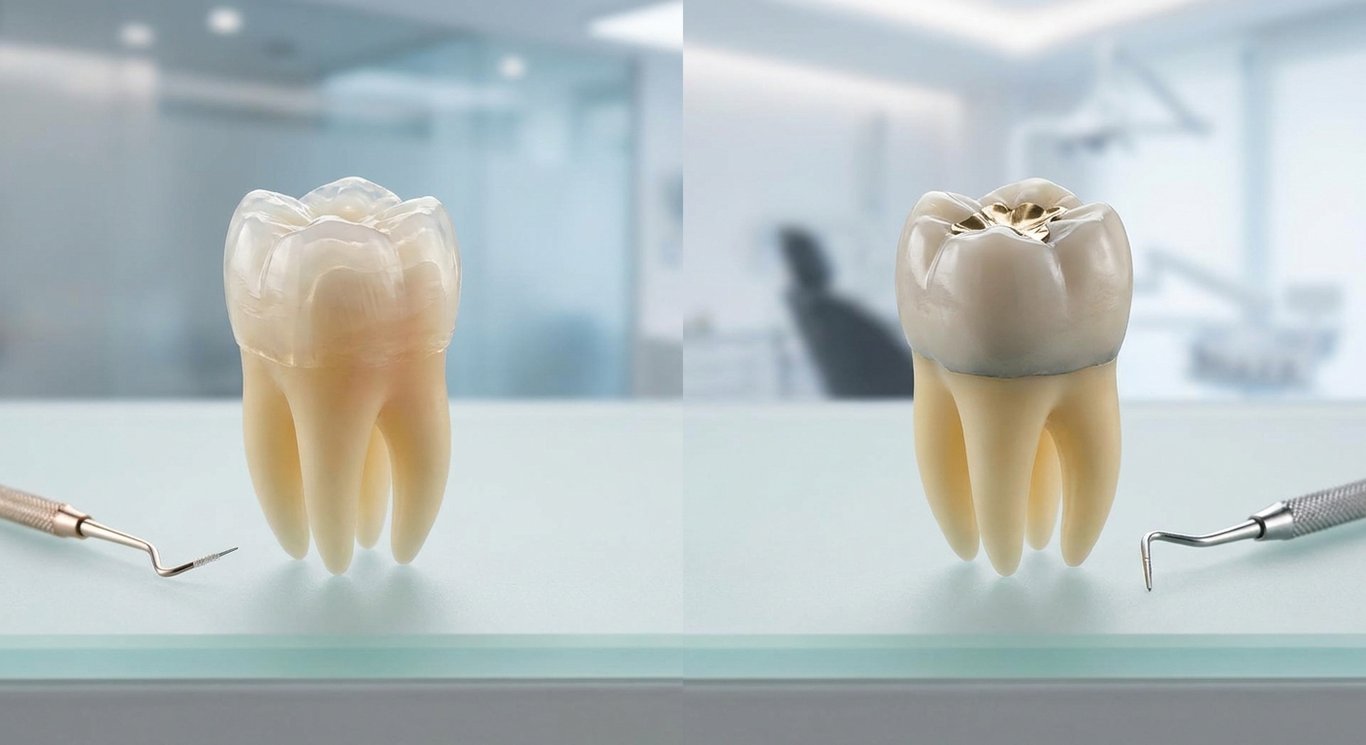
When you place biomimetic restorations and traditional crowns or fillings side by side conceptually, the differences become clear fairly quickly. Traditional full crowns require significant tooth reduction — the dentist must grind the tooth into a peg-like shape so the crown can fit over it. Conventional fillings rely on mechanical undercuts, meaning the cavity is shaped in a way that physically locks the filling in place. Biomimetic restorations, by contrast, rely on adhesive bonding and conservative preparation, preserving the natural shape of the tooth and holding the restoration in place through chemistry rather than geometry.
This difference in approach has real consequences for the tooth. Biomimetic treatments prioritize partial coverage — covering only what needs to be covered — and use adhesion to create a seal that integrates the restoration with the remaining tooth structure. Conventional crowns encircle the entire tooth, which means healthy tissue on every side gets sacrificed to make the crown fit. While a crown is sometimes the right choice, using one when a bonded onlay would suffice means the patient loses healthy tooth structure they didn't need to lose.
The implications extend to long-term outcomes as well. Conventional restorations can sometimes create stress concentrations at the margins — the edges where the restoration meets the tooth — which can lead to fractures or secondary decay over time. Biomimetic restorations, because they're designed to distribute stress more naturally and seal margins more effectively, aim to reduce these complications. The goal is a restoration that ages gracefully rather than one that sets up the next problem.
It's worth being clear, though: conventional dentistry still has an important role to play. There are clinical situations where a full crown is genuinely the best option — severely broken-down teeth, teeth that have already had root canals, or cases where adhesion alone can't provide adequate support. Biomimetic dentistry doesn't replace traditional methods; it expands the toolkit available to clinicians and gives patients more options for preserving their natural teeth. The two approaches can and should coexist, with the biomimetic philosophy guiding treatment toward the most conservative effective option in each case.
Future Directions: Regenerative and Bioactive Biomimetic Dentistry
The current state of biomimetic dentistry is impressive, but researchers are already working on the next frontier: materials and techniques that don't just imitate tooth structure but actively encourage the body to rebuild it. Bioactive dental materials represent a particularly exciting area of development. These substances are designed to interact with the biological environment of the tooth — releasing ions, triggering cellular responses, or creating conditions that promote remineralization and even tissue regeneration. The idea is to move from passive replacement toward active biological partnership.
Among the most promising developments are smart composites that release calcium and phosphate ions to strengthen the surrounding dentin over time, as well as scaffold-based approaches that could theoretically guide the formation of new dentin or enamel-like tissue. Some researchers are exploring materials that respond to changes in the oral environment — like shifts in pH caused by bacterial activity — by releasing protective agents precisely when and where they're needed. These aren't science fiction; they're active areas of research with real clinical implications on the horizon.
As these innovations mature and make their way into clinical practice, the practice of dentistry could shift in a profound way — from a discipline focused on replacing lost structure to one capable of regenerating it. That would represent the fullest expression of the biomimetic ideal: not just mimicking nature, but harnessing it. For patients, that future means dental care that works increasingly in harmony with the body's own biology, producing outcomes that are more durable, more comfortable, and more genuinely natural than anything currently possible.
Frequently Asked Questions About Biomimetic Dentistry
Is biomimetic dentistry safe and well-researched?
Biomimetic dentistry is built on established restorative materials and evidence-based adhesive techniques that have been refined over decades of clinical use. The bonding systems, composite resins, and ceramics used in biomimetic procedures are well-studied and widely accepted in modern dentistry. The biomimetic philosophy itself is supported by a growing body of clinical research and experience, with an increasing number of practitioners and academic institutions exploring and validating its principles. As with any dental treatment, the quality of outcomes depends significantly on the skill and training of the clinician, so it's important to seek care from a dentist who has specific education and experience in biomimetic approaches.
How long do biomimetic restorations last compared to traditional fillings or crowns?
Longevity is always influenced by individual factors — the complexity of the case, a patient's bite forces, oral hygiene habits, and dietary choices all play a role. That said, biomimetic restorations are specifically designed to extend the functional life of teeth by preserving more natural structure, achieving stronger adhesive bonds, and distributing stress more naturally. By reducing the mechanical and biological stresses that cause restorations to fail prematurely, biomimetic dentistry aims to minimize the need for future invasive procedures, giving each restored tooth the best possible chance of lasting for many years.
Is biomimetic dentistry more expensive than conventional treatment?
The cost of biomimetic procedures can be similar to conventional treatment in some cases, and moderately higher in others, depending on the complexity of the restoration and the materials involved. The additional time and skill required for meticulous layering, bonding, and anatomical sculpting can factor into the overall cost. However, it's important to consider the long-term value: by potentially reducing the need for retreatments, root canals, crowns, and extractions over time, biomimetic dentistry may actually lower a patient's total dental expenditure across their lifetime. Many patients and clinicians view it as an investment in long-term oral health rather than simply a higher upfront cost.
Can biomimetic dentistry prevent the need for root canals?
While biomimetic dentistry can't guarantee that root canals will never be needed, it is specifically designed to reduce the risk of reaching that point. By using conservative preparation that minimizes trauma to the pulp, applying strong seals that block bacterial infiltration, and managing stress distribution to prevent crack propagation, biomimetic strategies can sometimes halt or slow the progression of damage that would otherwise lead to pulp death and endodontic treatment. It's not a magic solution, but it's a thoughtful, evidence-informed approach to keeping the tooth alive and functional for as long as possible.
How can I find a dentist who practices biomimetic dentistry?
Finding a biomimetic dentist starts with knowing what to look for. Search for dental practices that specifically mention biomimetic dentistry, minimally invasive dentistry, or adhesive restorative dentistry in their descriptions of services. Look for dentists who have pursued additional training through organizations focused on biomimetic or minimally invasive approaches, as this signals a genuine commitment to the philosophy rather than just the terminology. During a consultation, don't hesitate to ask directly: How do you approach preserving tooth structure? What materials do you use and why? How do you decide between a filling, onlay, or crown? A dentist who practices biomimetic principles will be happy to walk you through their reasoning — and their answers will tell you a lot.
Conclusion: Embracing the Biomimetic Revolution in Everyday Dental Care
Biomimetic dentistry represents something genuinely new in how we think about restoring teeth — a shift away from aggressive, replacement-focused treatments and toward nature-inspired, preservation-based care that seeks to rebuild teeth so they function, feel, and look the way they did originally. The key insights from this article come back to a few central ideas: conserving healthy tooth structure is always worth the effort; advanced adhesive and layering techniques make conservative restorations stronger and more durable than ever before; and selecting materials that replicate the properties of enamel and dentin leads to better comfort, longer-lasting results, and improved esthetics. These aren't minor refinements — they represent a fundamentally different way of practicing restorative dentistry.
If you're facing restorative dental work, it's worth having a conversation about biomimetic options. Ask your dentist how they approach tooth preservation, what materials they use, and whether an onlay might be appropriate instead of a crown. If you're starting fresh with a new provider, consider seeking out a dentist who specifically practices minimally invasive or biomimetic dentistry. The questions you ask today could make a meaningful difference in the health of your teeth for decades to come. Biomimetic dentistry isn't just a trend — it's a smarter, more respectful approach to one of the most important structures in your body. Your teeth were built by nature to last a lifetime, and biomimetic dentistry is designed to help them do exactly that.