Replacing a Missing Tooth: Implants, Bridges, and Dentures Explained
Published 27 min read
Losing a tooth is more than just a cosmetic concern — it affects how you eat, how you speak, and even how you feel about yourself. A gap in your smile can quietly cause a chain reaction of problems, from shifting teeth and bone loss to changes in your facial structure over time. Fortunately, modern dentistry offers several effective solutions: dental implants, fixed bridges, and dentures. Each option has its own strengths, and understanding the differences can make a huge impact on the choice you make for your long-term oral health.
This guide is designed for anyone who has recently lost a tooth, is considering tooth replacement, or simply wants to understand their options before walking into a dentist's office. Whether you're weighing cost, comfort, or longevity, this article will walk you through everything you need to know — from how each treatment works to what recovery looks like and how to care for your new smile. By the end, you'll have a clear, confident foundation for a conversation with your dental provider.
Understanding What Happens When You Lose a Tooth
When a tooth goes missing, the effects show up almost immediately. Chewing becomes uneven, putting extra pressure on the surrounding teeth. Your bite can shift in subtle but significant ways, which may lead to jaw discomfort or even headaches. Neighboring teeth, no longer held in place by their companion, often begin to drift toward the gap — a process that can throw off your entire dental alignment over time.
The longer-term consequences are even more serious. One of the most overlooked effects of tooth loss is jawbone deterioration. Your tooth roots actually stimulate the jawbone every time you chew, keeping it dense and healthy. Without that stimulation, the bone begins to shrink — a process called resorption. Over the years, this can cause your face to take on a sunken appearance, particularly around the cheeks and chin. Speech can also be affected, especially when front teeth are missing, and the risk of losing additional teeth increases as the surrounding structure weakens.
The good news is that timely replacement can prevent or significantly slow down most of these problems. Dental implants directly replace the tooth root and stimulate the jawbone. Bridges restore chewing function and prevent shifting. Dentures fill gaps and restore a functional bite. Each option addresses these concerns differently, which is why understanding them in detail matters so much before making a decision.
Overview of Your Tooth Replacement Options
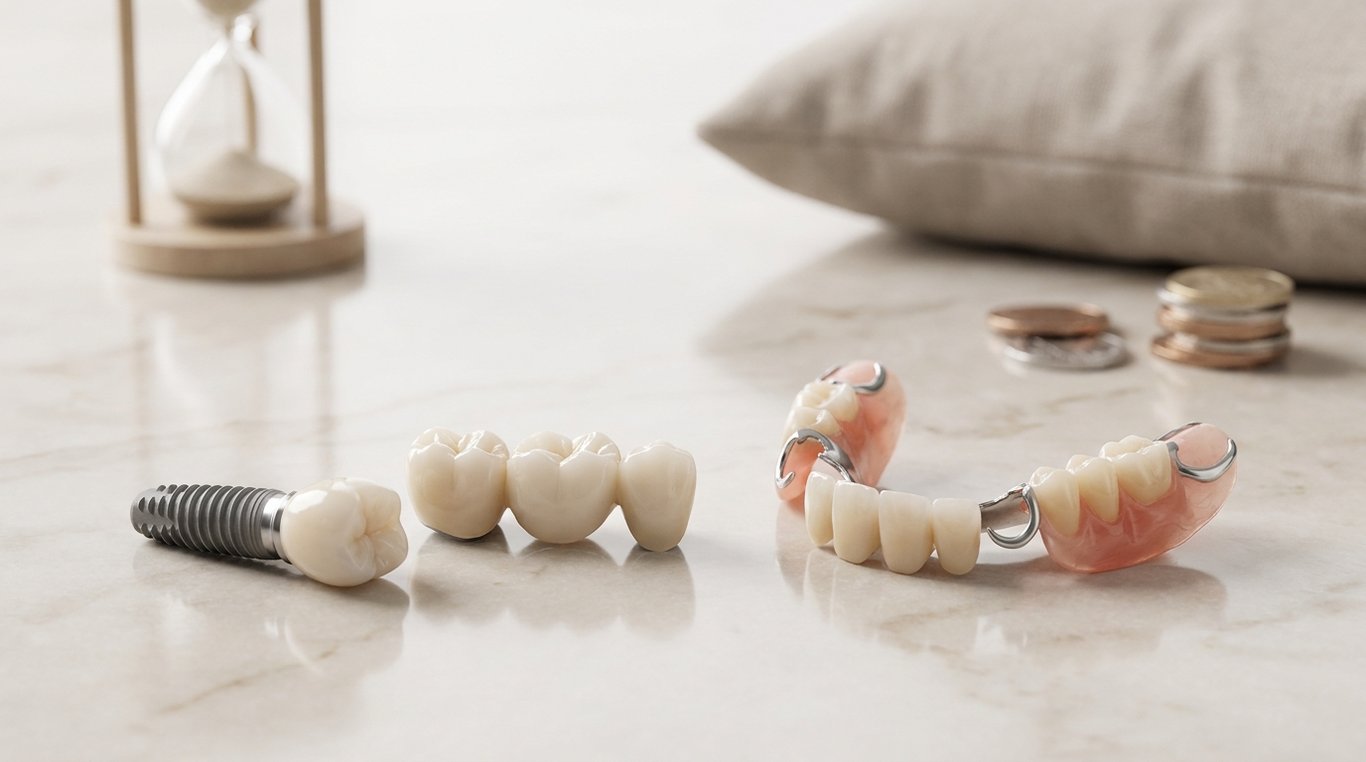
Dental implants are widely considered the most advanced tooth replacement option available today. A small titanium or zirconia post is surgically inserted into the jawbone, acting as an artificial tooth root. Once it fuses with the bone — a process that takes several months — a crown is placed on top, creating a result that looks and functions almost exactly like a natural tooth. Implants are typically recommended for patients with good bone density and overall oral health who want a long-lasting, permanent solution.
Fixed dental bridges, on the other hand, take a different approach. Rather than anchoring into the jaw, a bridge spans the gap between two existing teeth. The neighboring teeth (called abutment teeth) are shaped and crowned, and an artificial tooth — called a pontic — hangs in between to fill the space. Bridges are a solid option for patients who have healthy adjacent teeth and want a non-removable restoration without the surgical process of an implant.
Dentures are removable appliances that replace one or more missing teeth and are available in two main forms: partial dentures for patients who still have some natural teeth, and full dentures for those who have lost an entire arch. They sit on the gums and are held in place by suction, adhesive, or clasps. Dentures are often preferred when multiple teeth are missing, when surgery isn't an option, or when budget is a significant concern. They've come a long way in terms of appearance and comfort, though they do come with their own set of trade-offs.
Dental Implants Explained: Structure, Procedure, and Benefits
What Is a Dental Implant?
A dental implant is essentially a three-part system designed to mimic the structure of a natural tooth from root to crown. The first component is the implant post itself — a small screw made from biocompatible titanium or zirconia that is surgically placed into the jawbone. Above that sits the abutment, a connector piece that links the post to the visible part of the restoration. Finally, a custom-made crown is attached on top, crafted to match the shape, size, and color of your surrounding teeth. Together, these three parts create a replacement tooth that is virtually indistinguishable from the real thing.
What makes implants particularly versatile is that the post can support more than just a single crown. Multiple implants can anchor a fixed bridge to replace several consecutive missing teeth. In cases of full tooth loss, a series of strategically placed implants can support an entire arch of teeth — a solution often called All-on-4 or implant-supported dentures. As the post integrates with the surrounding bone through a process called osseointegration, it becomes a stable, permanent part of your jaw — which is what gives implants their remarkable longevity and function.
Implant Placement Process and Healing
Before any surgery takes place, your dentist or oral surgeon will conduct a thorough assessment. This typically includes a full dental examination, digital X-rays, and often a 3D cone beam CT scan to evaluate the quality and quantity of your jawbone. Gum health is also assessed, since active gum disease must be treated before implant placement. This planning phase is critical — it determines whether you're a good candidate and allows the provider to map out the exact position and angle for the implant post.
The surgical placement itself is performed under local anesthesia, and most patients report feeling pressure rather than pain during the procedure. After the post is inserted, a healing period of three to six months typically follows, during which osseointegration takes place. During this time, the bone grows around and bonds with the titanium post, creating a secure foundation. Follow-up visits are scheduled to monitor healing, and a temporary restoration may be provided to maintain aesthetics and function in the meantime.
Once osseointegration is confirmed, the abutment is attached and impressions or digital scans are taken to fabricate the final crown. When the permanent crown is secured, most patients are pleasantly surprised by how natural it looks and feels. There may be minor sensitivity or soreness in the days following each stage of treatment, but this typically resolves quickly with over-the-counter pain relief and careful eating habits during recovery.
Benefits and Limitations of Implants
The benefits of dental implants are hard to overlook. They offer the closest thing to a natural tooth in terms of appearance, feel, and function. Chewing efficiency is excellent — far superior to dentures and comparable to a natural tooth. Perhaps most importantly, the implant post stimulates the jawbone, preventing the bone loss that occurs with other replacement options. And because implants don't rely on neighboring teeth for support, those teeth remain untouched and intact.
That said, implants aren't for everyone. They require sufficient bone volume to anchor the post securely — patients who have experienced significant bone loss may need a bone graft procedure first, which adds time and cost. The implant process involves minor oral surgery, which carries the usual risks of infection, bleeding, or nerve sensitivity, though serious complications are rare. The upfront cost is also higher than bridges or dentures, which can be a barrier for some patients, particularly when insurance coverage is limited.
With proper care, dental implants can last 20 years or more — and in many cases, a lifetime. The crown on top may need replacement after 10 to 15 years due to normal wear, but the implant post itself is designed to be permanent. Factors that influence long-term success include maintaining excellent oral hygiene, avoiding smoking, managing conditions like diabetes, and attending regular dental checkups. Patients who commit to these habits tend to see the best outcomes over the long run.
Dental Bridges Explained: Types, Procedure, and Pros & Cons
What Is a Dental Bridge and When Is It Used?
A dental bridge is a fixed restoration that literally "bridges" the gap left by one or more missing teeth. It consists of two or more crowns placed on the teeth on either side of the gap — these are called abutment teeth — with one or more artificial teeth (pontics) suspended between them. The entire structure is cemented in place and functions as a single unit, restoring both the appearance and function of the missing tooth without any removable components.
Bridges are most commonly recommended when a patient is missing one or a few consecutive teeth and the neighboring teeth are healthy enough to serve as anchors. They're also a good option for patients who are not candidates for implants due to insufficient bone or medical reasons, or for those who prefer to avoid surgery altogether. When the surrounding teeth already have large fillings or crowns, a bridge can be an especially practical choice since those teeth will be crowned anyway.
Types of Bridges and Treatment Steps
The most common type is the traditional fixed bridge, which involves reshaping the abutment teeth by removing a layer of enamel so that crowns can be placed over them. Impressions or digital scans are taken and sent to a dental lab where the bridge is custom-made. A temporary bridge is worn in the meantime, and the permanent restoration is cemented in place at a follow-up appointment. The result is a stable, non-removable replacement that looks and functions well.
Beyond the traditional design, there are a few other types worth knowing about. A cantilever bridge is anchored on only one side, which is useful when there's only one neighboring tooth available — though it's less commonly used due to the increased stress it places on that single anchor tooth. A Maryland bridge (also called a resin-bonded or adhesive bridge) uses metal or porcelain wings bonded to the backs of adjacent teeth, making it a more conservative option that doesn't require significant reshaping. Maryland bridges are often used for front teeth where biting forces are lower.
The entire bridge process typically takes two to three appointments spread over a few weeks. Most patients experience some sensitivity around the abutment teeth after preparation, which usually settles within a few days. After the permanent bridge is placed, there may be a brief adjustment period as you get used to the feel of the new restoration, but most people adapt quickly and can return to normal eating and speaking without major disruption.
Advantages and Drawbacks of Bridges
One of the biggest advantages of a bridge is speed. Compared to the multi-month process of implant treatment, a bridge can be completed in just a few weeks. It's also a fixed, non-removable solution — which many patients prefer over the idea of taking something in and out of their mouth each day. In terms of cost, bridges are generally less expensive than implants upfront, making them a more accessible option for many people.
However, bridges do come with some notable drawbacks. The most significant is that healthy neighboring teeth must be reshaped and crowned to support the bridge — a permanent and irreversible alteration. These prepared teeth can sometimes become more sensitive or vulnerable to decay over time, especially at the margins where the crown meets the gum line. Additionally, because the pontic sits on top of the gum rather than integrating with the bone, the underlying jawbone still experiences resorption beneath the missing tooth site.
With good care, a well-made bridge can last 10 to 15 years or longer. Regular brushing, flossing under the bridge with a floss threader or interdental brush, and routine dental visits all contribute to its longevity. For patients who want a fixed solution, are not candidates for implants, or are working within a tighter budget, a bridge can be an excellent middle-ground option that balances function, aesthetics, and cost effectively.
Dentures Explained: Partial, Full, and Implant-Supported Options
Partial vs Full Dentures
Partial dentures are designed for patients who are missing several teeth but still have healthy natural teeth remaining. They consist of artificial teeth attached to a gum-colored acrylic or metal framework, which clips around the existing natural teeth using metal clasps or precision attachments. Partial dentures are a practical solution when multiple teeth in different areas of the mouth need to be replaced, and they can be modified if additional teeth are lost in the future.
Full dentures, sometimes called complete dentures, replace an entire arch of teeth — either upper, lower, or both. They rest directly on the gum tissue and rely on a combination of fit, suction, and sometimes denture adhesive for retention. Full dentures are typically recommended when all teeth in an arch are missing or need to be extracted. They can be made in advance (immediate dentures) so that you're never without teeth during the healing process, or fabricated after healing is complete for a more precise fit.
Both partial and full dentures can restore a natural-looking smile and allow for reasonable chewing function. They're often the most accessible option for patients who need to replace many teeth at once without the time or cost involved in multiple implants. That said, expectations should be realistic — dentures don't function quite like natural teeth, and there is an adaptation period involved. Patients who are in good general health, have adequate gum tissue, and are committed to proper care tend to benefit most from this option.
Implant-Supported Dentures
Implant-supported dentures combine the best of both worlds by using dental implants to anchor and stabilize a removable or fixed denture. Instead of relying solely on gum suction or adhesive, the denture snaps onto or is secured by a series of implants — typically two to six per arch. This dramatically improves retention, meaning the denture stays firmly in place while eating and speaking. Chewing efficiency is significantly better than with traditional dentures, and patients often report a major boost in confidence and comfort.
Compared to traditional removable dentures, implant-supported options come at a higher cost and require surgical placement of the implants. However, they also offer the added benefit of stimulating the jawbone, which slows down bone resorption. Maintenance is similar to traditional dentures in that the appliance itself is cleaned regularly, but the implant components also require attention during professional cleanings. For patients who have struggled with loose or uncomfortable conventional dentures, the upgrade to implant-supported dentures can be genuinely life-changing.
Pros, Cons, and Adaptation Period
Traditional dentures have several clear advantages. They can replace a large number of missing teeth in a single restoration, making them ideal for patients with extensive tooth loss. For full dentures, no surgery is required — the process involves impressions, fittings, and adjustments rather than any invasive procedures. The initial cost is typically lower than implants or implant-supported options, which makes dentures a financially accessible solution for many patients.
On the flip side, dentures come with a real adjustment period that shouldn't be underestimated. New denture wearers often experience soreness, increased saliva production, and difficulty speaking or eating for the first few weeks. Chewing efficiency is reduced compared to natural teeth or implants, and certain foods — particularly hard, sticky, or crunchy items — may need to be avoided or approached carefully. Some patients also find that full dentures slightly mute the sense of taste, since the upper denture covers the palate.
Caring for dentures requires a consistent daily routine. They should be removed and cleaned after meals when possible, brushed thoroughly with a soft brush and non-abrasive denture cleaner, and soaked overnight in a denture solution or water. Dentures should never be left to dry out, as they can warp. Regular dental visits are important for monitoring fit — as the jawbone changes shape over time, dentures may need relining or rebasing to maintain a proper fit. Most dentures need to be replaced every five to eight years.
Comparing Implants, Bridges, and Dentures: Cost, Comfort, and Longevity
When comparing these three options side by side, function and everyday comfort are often the deciding factors for patients. Dental implants feel the most like natural teeth — they're fixed, stable, and allow you to eat, speak, and smile without any special considerations. Bridges are also fixed and provide good chewing function, though they don't stimulate the underlying bone. Dentures, while functional, require more adjustment and offer the least chewing efficiency of the three — particularly traditional removable dentures without implant support.
Cost is a significant factor, and it's worth thinking about both short-term and long-term value. Implants tend to have the highest upfront cost, often ranging from several hundred to several thousand dollars per tooth depending on your location, the complexity of your case, and whether preparatory procedures like bone grafting are needed. Bridges are moderately priced and may be partially covered by dental insurance. Dentures are typically the most affordable option upfront, though ongoing maintenance, relines, and eventual replacement add up over time. Insurance coverage varies widely, so it's worth checking your specific plan before making any decisions.
Durability is another area where the three options differ considerably. Implants are built to last decades — potentially a lifetime — with proper care, making them the most cost-effective option over the long term for many patients. Bridges typically last 10 to 15 years before needing replacement, and if one part fails, the entire bridge usually needs to be remade. Dentures generally need to be replaced every five to eight years and may require periodic relines in between as the jaw changes shape. Each option has different repair needs, and understanding this upfront helps set realistic expectations.
Ultimately, there is no universal "best" option — it truly depends on the individual. Implants tend to suit patients who are healthy, have good bone density, and want a permanent, low-maintenance solution. Bridges are a great fit for those who want a fixed restoration quickly and have strong neighboring teeth. Dentures work well for patients with extensive tooth loss, those who prefer to avoid surgery, or those with budget constraints. The right choice is the one that aligns with your health, lifestyle, and goals — and that's a conversation best had with your dentist.
How to Decide Which Option Is Right for You
Your oral health and anatomy play a major role in determining which tooth replacement option is realistic for you. Bone density is particularly important — implants require a sufficient volume of healthy bone to anchor securely, while bridges and dentures don't have this requirement. The number and location of missing teeth also matters: a single missing molar in the back of the mouth presents different options than multiple missing front teeth. Your dentist will evaluate gum health, the condition of remaining teeth, and overall oral hygiene before making any recommendation.
Beyond clinical factors, lifestyle considerations carry real weight in this decision. Age can influence healing capacity and long-term planning. Certain medical conditions — such as uncontrolled diabetes, autoimmune disorders, or a history of radiation to the jaw — can affect implant success rates. Smoking significantly increases the risk of implant failure and should be factored into any treatment plan. Budget, aesthetic priorities, and how much maintenance you're willing to do on a daily basis are all personal factors that will shape which option makes the most sense for you.
Getting a professional assessment is non-negotiable. A thorough consultation with a dentist or specialist — whether a prosthodontist, oral surgeon, or periodontist — gives you the clinical information you need to make a sound decision. Don't hesitate to seek a second opinion, especially for complex cases or when significant investment is involved. Come prepared with questions: ask about success rates, what happens if the restoration fails, what the total cost will be including all stages, and whether any preparatory treatments are needed beforehand.
It's also worth knowing that your options don't always have to be all-or-nothing. Some patients benefit from phased treatment — starting with a bridge or partial denture while planning for implants later. Others combine options, using implants in some areas and a bridge or denture in others. Your dentist can help you weigh the pros and cons of each approach in the context of your specific situation, making the process feel far less overwhelming when you approach it as a team effort.
What to Expect Before, During, and After Treatment
Before any tooth replacement procedure begins, your dental team will gather a complete picture of your oral health. This typically starts with a detailed medical and dental history, followed by a clinical examination of your teeth, gums, and jaw. X-rays are standard, and for implant planning, a 3D cone beam CT scan may be taken to assess bone structure in detail. Impressions or digital scans of your teeth are used for planning and fabricating restorations. This diagnostic phase ensures that the treatment plan is tailored specifically to your mouth.
What happens during the procedure depends on which treatment you're having. Implant surgery is performed under local anesthesia, and sedation options are available for anxious patients — most people find it more comfortable than they expected. Bridge preparation involves numbing the area while the abutment teeth are shaped, followed by impressions and temporary restorations. Denture fittings are non-invasive and involve a series of try-in appointments to refine fit and appearance before the final appliance is delivered. Chair time varies: denture appointments are generally shorter, while implant procedures can take an hour or more per session.
Recovery looks different depending on the treatment. Implant patients may experience swelling, bruising, and mild discomfort for a few days after surgery, with a soft diet recommended during healing. Bridge patients typically have a shorter recovery, mainly dealing with temporary sensitivity around the prepared teeth. New denture wearers face an adaptation period of several weeks as their mouth adjusts to the appliance. Follow-up visits are scheduled for all three options to monitor healing, check fit, and make any necessary adjustments — these appointments are just as important as the procedure itself.
Caring for Your New Tooth Replacement: Maintenance and Follow-Up
Dental implants are remarkably easy to care for in day-to-day life. Brush around the implant crown twice a day with a soft-bristled toothbrush, just as you would with natural teeth. Flossing is important — use regular floss, a floss threader, or a water flosser to clean around the base of the crown where it meets the gum. Interdental brushes are also helpful for reaching tight spaces. Professional cleanings every six months allow your hygienist to remove any buildup around the implant and check for early signs of peri-implantitis, which is inflammation around the implant similar to gum disease.
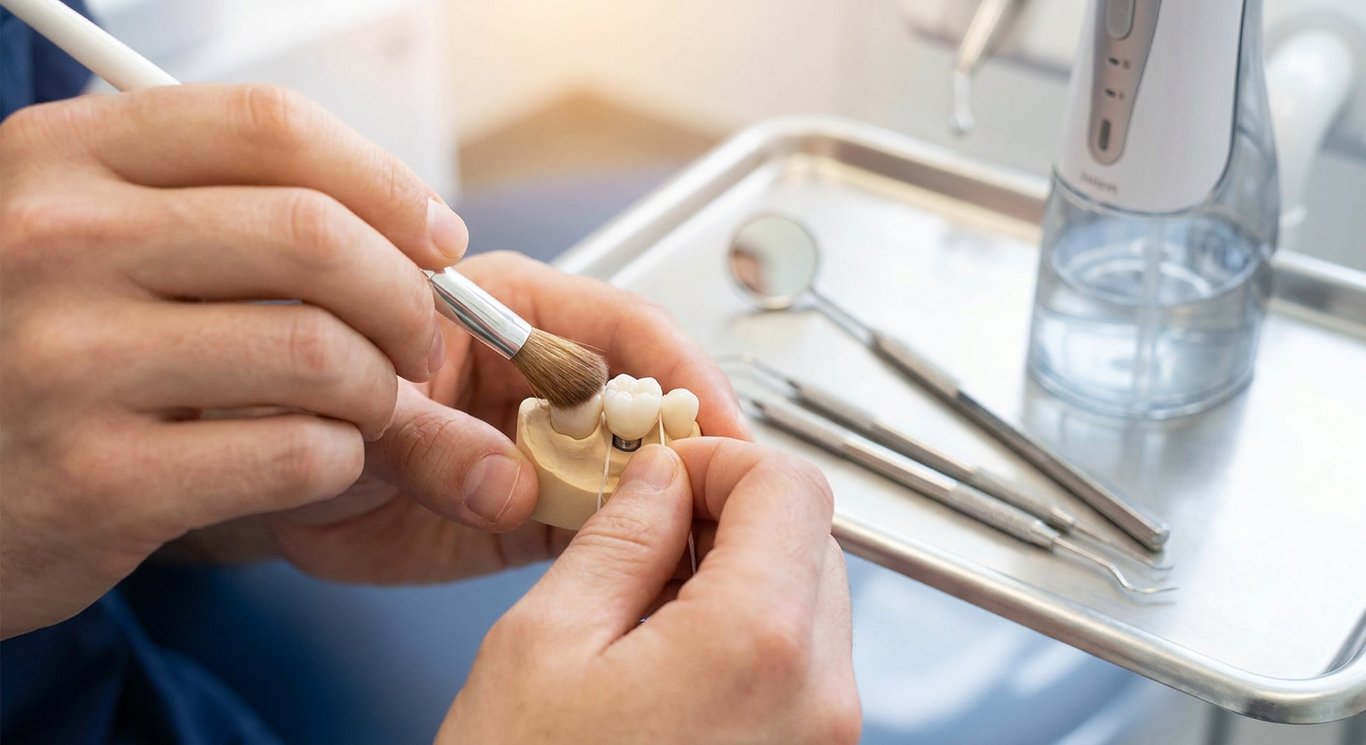
Bridges require a bit more attention because food and bacteria can accumulate underneath the pontic — the area where the artificial tooth sits over the gum. A floss threader or a specially designed bridge floss makes it possible to clean beneath the bridge each day. Water flossers are also effective for this area. Dentures need to be removed and rinsed after meals, brushed with a soft brush and non-abrasive cleaner, and soaked overnight. Never use regular toothpaste on dentures, as it can scratch the surface and create areas where bacteria thrive. Handle dentures over a soft surface or basin of water to avoid breakage if dropped.
Long-term follow-up is essential for all three options, not just in the early months but throughout the life of the restoration. Regular dental checkups allow your provider to monitor the fit and function of your restoration, check the health of surrounding teeth and gums, and catch any developing issues early. Bridges and dentures may need adjustments or relining over time as your jaw and gum tissue change. Implants should be checked at every visit to ensure the surrounding bone is stable and the crown remains intact. Staying consistent with these visits is one of the best things you can do to protect your investment.
Risks, Complications, and When to Call Your Dentist
Like any dental or surgical procedure, implants carry some degree of risk. The most common complications include infection at the implant site, delayed healing, and in rare cases, implant failure — where the post doesn't fully integrate with the bone. Peri-implantitis, a form of gum inflammation around the implant, can develop if oral hygiene is neglected, and if left untreated, it can eventually lead to bone loss and implant loss. Nerve sensitivity or numbness is another possible but uncommon complication, usually related to implant placement in the lower jaw. Fortunately, most of these risks can be minimized with proper planning, skilled placement, and diligent aftercare.
Bridges and dentures have their own set of potential issues. A bridge can become loose or fracture over time, especially under heavy biting forces. Decay can develop at the margins of the crowns on the abutment teeth — a particular concern if brushing and flossing around the bridge is inconsistent. Dentures may develop sore spots as the fit changes, crack or chip if dropped, or become loose as the jawbone resorbs. Partial denture clasps can sometimes irritate or damage the teeth they attach to if the fit isn't monitored regularly.
Knowing when to call your dentist is important. Seek prompt attention if you notice persistent pain or swelling around an implant or bridge, a loose or cracked restoration, bleeding gums that don't resolve, or sore spots from a denture that don't improve with time. Early intervention almost always leads to simpler, less expensive solutions — a small adjustment or minor repair is far easier to manage than a full restoration failure. When something doesn't feel right, trust your instincts and make that call sooner rather than later.
Conclusion: Key Takeaways and Next Steps for Replacing a Missing Tooth
Replacing a missing tooth is one of the most important decisions you can make for your oral health, and the good news is that you have excellent options. Dental implants offer the most natural look and feel, preserve jawbone, and can last a lifetime with proper care — but they require surgery, sufficient bone, and a higher upfront investment. Bridges provide a fixed, non-removable solution that's faster and more affordable, though they do involve reshaping neighboring teeth and don't prevent bone loss beneath the gap. Dentures are the most accessible option for replacing multiple teeth, but they come with an adjustment period and require consistent maintenance. Each option has real value — the key is finding the one that fits your unique situation.
Use this guide as your starting point, not your final answer. Bring it with you to your consultation, use it to formulate questions, and let it help you understand what your dentist recommends and why. The most important next step is to schedule a professional evaluation so you can get personalized advice based on your specific oral health, bone structure, and goals. Know your priorities — whether that's longevity, cost, appearance, or convenience — and don't be afraid to ask about all your options. An informed patient is always in a better position to make a decision they'll feel good about for years to come.
Frequently Asked Questions About Replacing a Missing Tooth
1. Is a dental implant always the best option for a missing tooth?
Dental implants are often referred to as the gold standard in tooth replacement, and for good reason — they're stable, long-lasting, and function almost identically to natural teeth. However, they're not the right fit for everyone. Patients with insufficient jawbone density may need a bone graft before implant placement, adding time and cost to the process. Certain medical conditions, medications, or lifestyle habits like smoking can also affect the success of implants. Budget is another real consideration, since implants typically cost more upfront than bridges or dentures. The best option is always the one that aligns with your individual health profile, financial situation, and personal preferences — which is why a thorough consultation with a dental professional is so important before deciding.
2. How long do implants, bridges, and dentures typically last?
Dental implants are designed for long-term durability — the implant post itself can last 20 years or even a lifetime with proper care, though the crown on top may need replacement after 10 to 15 years due to normal wear. Dental bridges typically last between 10 and 15 years before they may need to be replaced, depending on oral hygiene, bite forces, and the health of the abutment teeth. Dentures generally have a shorter lifespan of five to eight years before they need significant relines or full replacement, largely because the jawbone continues to change shape over time, affecting how the denture fits. In all cases, how well you care for your restoration — and how consistently you attend professional checkups — plays a major role in how long it lasts.
3. Are tooth replacement procedures painful?
Most tooth replacement procedures are far more comfortable than people expect, thanks to modern anesthesia and sedation techniques. Implant surgery is performed under local anesthesia, and patients typically feel pressure rather than sharp pain during the procedure. Some soreness, swelling, and mild discomfort in the days following surgery is normal and usually manageable with over-the-counter pain relievers. Bridge preparation involves numbing the area thoroughly, and post-procedure sensitivity around the prepared teeth typically fades within a week or two. Denture fittings are non-invasive and painless, though new dentures can cause soreness and irritation as the gums adapt — this usually resolves with adjustments from your dentist. Overall, pain management in modern dentistry is highly effective, and any discomfort is typically short-lived.
4. How much do implants, bridges, and dentures cost, and are they covered by insurance?
Costs vary significantly depending on your location, the complexity of your case, and the materials used. Generally speaking, dental implants are the most expensive option — a single implant with a crown can range from a few thousand dollars, and additional procedures like bone grafting add to that. Dental bridges are moderately priced and typically cost less than implants, especially when replacing a single tooth. Dentures are usually the most affordable upfront, with full dentures costing less than bridges or implants in most cases. Insurance coverage is inconsistent across plans — some policies cover a portion of bridge or denture costs under restorative benefits, while implant coverage is less common and often limited. It's worth contacting your insurance provider directly to understand what's covered, and asking your dental office about financing options if needed.
5. Can I eat normally with an implant, bridge, or denture?
Your ability to eat comfortably depends largely on which option you choose and how well you've adapted to it. Dental implants offer the closest experience to natural teeth — once fully healed, most patients can eat a wide variety of foods, including hard and crunchy items, without restriction. Bridges also allow for good chewing function, though you may want to be cautious with very sticky or hard foods that could stress the restoration. Dentures require the most dietary adjustment, particularly in the early weeks — soft foods are recommended during the adaptation period, and some foods like tough meats, hard raw vegetables, or very sticky items can remain challenging even long-term. Implant-supported dentures significantly improve chewing efficiency compared to traditional removable dentures, making mealtime a much more enjoyable experience for patients who make the upgrade.