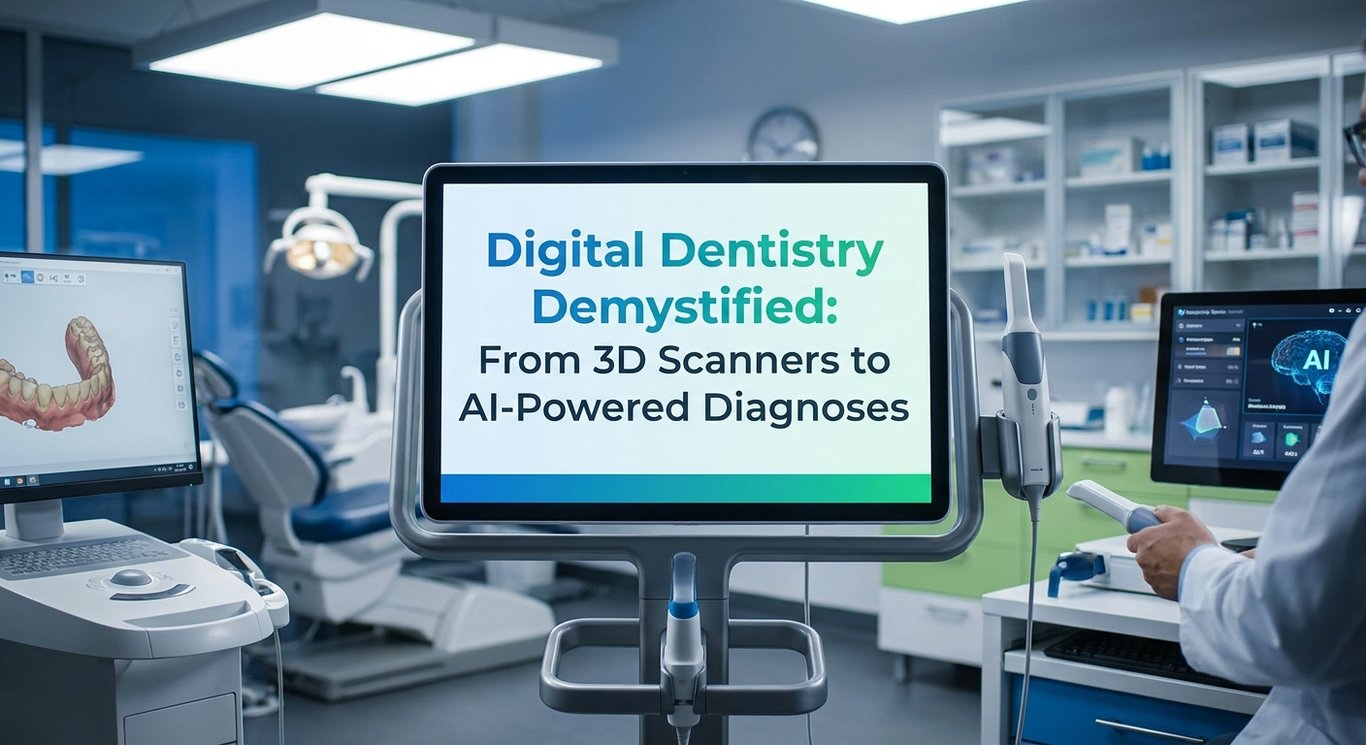
Digital Dentistry Demystified: From 3D Scanners to AI-Powered Diagnoses
Published 16 min read
Introduction to Digital Dentistry and Why It Matters
Digital dentistry is exactly what it sounds like — dentistry that uses computer-based tools instead of older, manual methods. Think digital scanners instead of goopy impression trays, computer software instead of hand-drawn treatment plans, and precise fabrication machines instead of plaster molds. The shift from traditional analog workflows to digital processes has been building for years, and today it covers everything from how your teeth are scanned to how your crown is designed and made. It is a broad term that includes a wide range of technologies, all working toward the same goal: better, more efficient dental care.
This topic matters more than ever right now because the pace of adoption has accelerated dramatically. Patients are experiencing faster diagnostics, greater comfort during procedures, and more accurate results than previous generations could have imagined. Dentists are working with tools that help them catch problems earlier and plan treatments with a level of detail that simply was not possible before. Throughout this article, we will break down the major technologies driving this change — including 3D scanning, CAD/CAM systems, AI-powered diagnosis, and more — so you walk away with a clear picture of what digital dentistry actually involves and why it is worth paying attention to.
What Is Digital Dentistry?
At its core, digital dentistry refers to the use of digital technologies to perform dental procedures that were traditionally carried out with analog, mechanical, or manual tools. The key technologies include intraoral scanners that capture precise 3D images of your teeth, digital X-rays that produce instant and detailed radiographic images, cone beam computed tomography (CBCT) that creates full 3D views of the jaw and skull structures, CAD/CAM systems that design and mill restorations, and 3D printers that produce physical models and devices. Each of these tools replaces or significantly enhances a conventional method, improving both the process and the outcome.
What makes digital dentistry particularly powerful is how these technologies connect with each other. A modern digital dental workflow might start with an intraoral scan, feed that data into design software, and then send the final design directly to a milling machine or 3D printer — all within the same visit or a very short timeframe. It functions as both a diagnostic ecosystem and a restorative one, meaning the same digital infrastructure that helps a dentist spot a problem can also be used to design and produce the solution. This interconnected approach is what sets digital dentistry apart from simply using one or two modern gadgets in an otherwise traditional practice.
How 3D Scanners Are Changing Dental Impressions
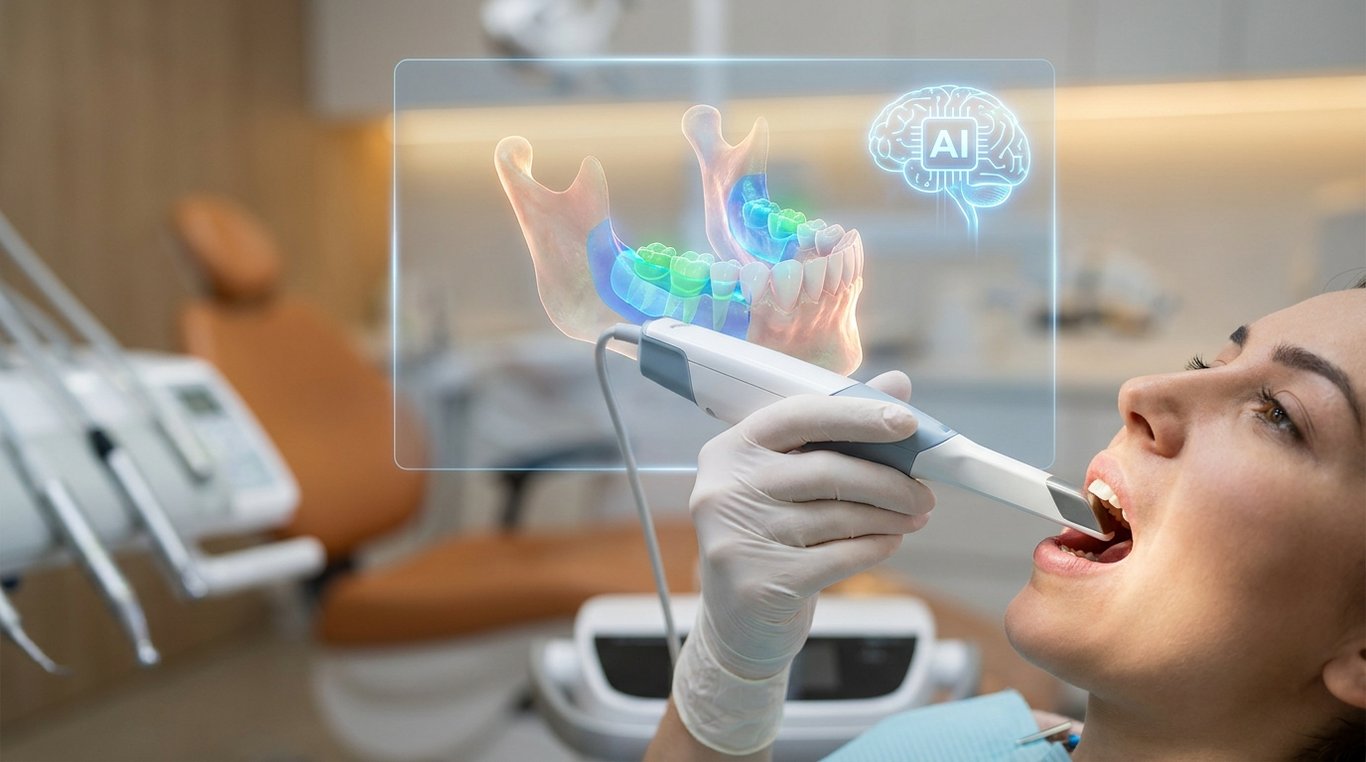
Intraoral 3D scanners are handheld devices that a dentist or hygienist moves around inside your mouth to capture thousands of images per second, which are then stitched together by software to create a highly detailed digital model of your teeth and gums. If you have ever had a traditional impression taken — where a tray filled with a thick, rubbery material is pressed into your mouth and held there for several minutes — you already understand why patients tend to prefer the scanner. There is no gagging, no mess, and no waiting for material to set. The digital model is also significantly more accurate than a physical impression, which can distort during removal or while being transported to a lab.
The practical applications of intraoral scanning are wide-ranging. Crowns, bridges, veneers, dental implants, clear aligners, and surgical guides can all be designed using data captured by these scanners. The elimination of messy impression materials alone is a major quality-of-life improvement for patients, but the real advantage goes deeper — digital scans can be stored, shared with specialists instantly, and used repeatedly without any degradation in quality. For implant planning and surgical procedures in particular, the precision of a 3D scan can make a meaningful difference in how well the final result fits and functions.
Digital Imaging Tools Used in Modern Dental Care
Digital imaging in dentistry goes well beyond the standard X-ray. Today's dental practices use digital radiographs that produce instant images with significantly less radiation than traditional film X-rays, as well as cone beam computed tomography (CBCT) scans that create detailed three-dimensional images of the teeth, jaw, nerves, sinuses, and bone structure. High-resolution intraoral cameras can also capture close-up images of individual teeth, allowing dentists to see cracks, decay, and gum issues that might be easy to miss during a standard visual exam. Together, these tools give clinicians a much more complete picture of what is happening beneath the surface.
Beyond simply seeing more, digital imaging supports better decision-making at every stage of treatment. Earlier detection of cavities, bone loss, and other issues means less invasive treatment and better long-term outcomes. Digital images can also be displayed on a screen and explained to patients in real time, which improves communication and helps people understand what is happening in their own mouths. Whether the focus is restorative work, orthodontic planning, periodontal assessment, or surgical preparation, digital imaging gives both the dentist and the patient a clearer, more informed starting point.
How CAD/CAM and 3D Printing Support Treatment
CAD/CAM stands for computer-aided design and computer-aided manufacturing, and in dentistry it refers to the process of designing restorations digitally and then producing them with a milling machine. Once a digital scan of the tooth is taken, specialized software is used to design a crown, inlay, onlay, veneer, or denture with a high degree of precision. The design is then sent to a milling unit that carves the restoration out of a solid block of ceramic, composite resin, or other material. In many cases, this entire process can happen in a single appointment, eliminating the need for temporary crowns and multiple visits.
3D printing adds another layer of capability to this workflow. While milling is better suited for producing final ceramic restorations, 3D printing excels at producing surgical guides, orthodontic models, occlusal splints, and certain types of removable appliances. The combination of CAD/CAM design and 3D printing fabrication allows dental practices and labs to reduce turnaround time considerably while also offering a higher level of customization. A restoration or device that once took two or three weeks to produce through a traditional lab can now often be completed in a fraction of that time, with results that are tailored specifically to the patient's anatomy.
AI-Powered Diagnosis in Dentistry
Artificial intelligence is making its way into dental offices in a meaningful way, primarily by helping dentists analyze X-rays, 3D scans, and patient records more efficiently and accurately. AI systems trained on large datasets of dental images can flag areas of concern — such as early-stage cavities, bone loss, or unusual tissue patterns — that might be subtle enough to miss during a quick review. A common question is whether this means AI is replacing dentists, and the answer from virtually every credible source in the field is a clear no. AI functions as a decision-support tool, highlighting findings for the clinician to evaluate rather than making independent diagnoses or treatment decisions.
The range of clinical applications for AI in dentistry is growing quickly. Current systems are being used to detect cavities at early stages, identify signs of periodontal disease, assess endodontic anatomy, analyze orthodontic patterns for treatment planning, and even predict how certain conditions might progress over time. Predictive analytics and clinical decision support are two of the most promising areas, as they allow dentists to move beyond reactive care and toward a more proactive, data-driven approach to patient health. The technology is still evolving, but its role in improving diagnostic accuracy and consistency is already well established in clinical research.
Common Clinical Applications of Digital Dentistry
Digital tools have found a home in nearly every corner of modern dentistry. In restorative dentistry and prosthodontics, they support the design and fabrication of crowns, bridges, implants, and dentures. In orthodontics, digital scanning and AI-assisted planning have transformed how aligners and braces are prescribed. Periodontists use digital imaging to monitor bone levels and gum health over time, while endodontists rely on CBCT scans to navigate complex root canal anatomy. Implant dentistry has perhaps benefited most visibly, with digital workflows enabling surgical guides that place implants with remarkable precision.
What is worth emphasizing is that these tools do not just improve one step of the process — they improve the entire arc of care. From the initial diagnostic scan to the design of a restoration, through fabrication and final placement, and into follow-up monitoring, digital systems support better outcomes at every stage. The technology is not limited to high-end or specialized procedures; it is increasingly being used for routine care as well. As adoption continues to grow across specialties, the line between a "digital practice" and a standard one is becoming increasingly blurred in the best possible way.
Benefits for Dentists and Patients
For dental professionals, the advantages of going digital are substantial. Workflow efficiency improves when data can be captured, shared, and acted on quickly without the delays associated with physical lab work or manual processes. Treatment planning becomes more precise when clinicians have access to detailed 3D images and AI-assisted analysis. Restorations designed with CAD/CAM software tend to fit better and require fewer adjustments, which reduces chair time and increases patient satisfaction. On a broader level, digital systems help practices maintain consistency, reduce manual errors, and scale their services more effectively.
Patients feel the difference too, often in very direct ways. Appointments can be shorter when restorations are milled in-office. Procedures are more comfortable when a digital scan replaces a traditional impression. Patients can see their own imaging on a screen and understand their diagnosis in a way that a verbal explanation alone cannot achieve. The combination of shorter appointments, less discomfort, clearer communication, and more precise results adds up to a meaningfully better experience. For many people, these improvements are what finally make dental visits something they dread a little less.
Limitations, Risks, and Concerns to Understand
Digital dentistry is not without its challenges, and it is important to go in with a realistic picture. The upfront cost of equipment — intraoral scanners, CBCT units, milling machines, and 3D printers — can be significant, which is one reason not every practice has adopted every available tool. Training staff to use new systems takes time and investment, and software platforms can have steep learning curves. Integration between different devices and software platforms is not always seamless, and practices that use multiple vendors may find themselves managing compatibility issues. It is also worth noting that not every procedure calls for a fully digital approach, and many clinicians use a thoughtful blend of digital and traditional methods.
On the AI side of things, there are legitimate questions worth taking seriously. AI diagnostic tools are only as good as the data they were trained on, and errors do occur — which is precisely why clinical oversight remains essential. Data privacy is another real concern, since digital dental records and imaging files contain sensitive personal health information that must be protected carefully. Most authoritative discussions in the field frame digital dentistry as a powerful enhancement to clinical judgment rather than a substitute for it. The technology works best when it is validated, properly implemented, and used by skilled clinicians who understand both its capabilities and its limitations.

How to Choose a Digital Dentistry Workflow or Provider
Whether you are a patient evaluating a dental provider or a practice assessing new technology, knowing what to look for makes a real difference. For patients, it is worth asking whether a practice uses intraoral scanning, digital X-rays, or CBCT imaging, and how those tools are integrated into their treatment process. A practice that has invested in quality equipment and trained staff to use it well is likely to deliver a more efficient and accurate experience. It is also fair to ask whether the technology is used for your specific type of treatment, since some practices are digitally equipped in some areas but not others.
Practices evaluating new technology should consider scanner accuracy, imaging resolution, software compatibility, and the clinical experience of the team using the tools. It is also important to align technology choices with the types of cases the practice handles most frequently — a general dentistry practice has different needs than an implant-focused specialty clinic. Many successful practices take a hybrid approach, using digital tools where they offer the clearest advantage and maintaining traditional methods where they remain effective. The goal is always better patient care, not technology for its own sake.
The Future of Digital Dentistry
The trajectory of digital dentistry points toward faster, smarter, and more connected workflows. AI diagnostic tools are expected to become more sophisticated, with improved accuracy across a wider range of conditions and the ability to integrate data from multiple sources simultaneously. Automated design tools will likely reduce the time and expertise required to produce high-quality restorations, and stronger integration between scanners, imaging systems, and fabrication devices will make the end-to-end workflow even more seamless. Predictive analytics — using patient data to anticipate problems before they become serious — is one of the most exciting frontiers on the horizon.
Tele-dentistry is also poised to play a larger role, allowing dentists to consult with specialists remotely using shared digital records and imaging. Cloud-based platforms will make collaboration easier and more secure, regardless of where the clinician or patient is located. As imaging technology continues to improve, the level of detail available to clinicians will only increase, enabling even more personalized and precise treatment planning. The overall direction of the field is clear: dentistry is moving toward a model that is more data-driven, more individualized, and more capable of delivering the right care at the right time for each patient.
FAQ: Digital Dentistry Demystified: From 3D Scanners to AI-Powered Diagnoses
Question 1: What is digital dentistry, and how is it different from traditional dentistry?
Digital dentistry uses computer-based tools — such as intraoral scanners, digital X-rays, CBCT imaging, CAD/CAM systems, and 3D printers — to perform tasks that were previously done with manual, analog methods. Traditional dentistry relied on physical impressions made with putty-like materials, film X-rays, and restorations crafted by hand in a dental lab. The digital approach replaces or enhances these processes with technology that is generally faster, more accurate, and more comfortable for patients. The core difference is not just the tools themselves but the way they connect to create a more streamlined, data-driven workflow from diagnosis all the way through to treatment and follow-up.
Question 2: Are 3D dental scanners more accurate than traditional impressions?
In most clinical contexts, yes — intraoral 3D scanners produce highly accurate digital models that are free from the distortions that can affect physical impressions during removal or transport. Traditional impressions can shift, shrink, or be affected by moisture, all of which can impact how well a restoration fits. Digital scans capture precise data in real time, and that data can be reviewed, adjusted, and reused without any degradation in quality. Research consistently supports the accuracy of intraoral scanning for most restorative and orthodontic applications, and many clinicians consider digital scanning the superior option for complex cases requiring a high level of precision.
Question 3: Can AI diagnose dental problems on its own?
No — AI in dentistry is designed to assist clinicians, not replace them. Current AI systems analyze X-rays and other imaging to flag potential areas of concern, such as early cavities or bone loss, and present those findings to the dentist for review. The dentist then applies their clinical knowledge, patient history, and professional judgment to determine what the findings actually mean and what action, if any, is appropriate. AI improves the consistency and thoroughness of the review process, but the diagnosis and treatment decision always remain in the hands of a licensed professional. Think of it as a very capable second set of eyes rather than an autonomous decision-maker.
Question 4: Is digital dentistry more expensive for patients?
The cost picture is more nuanced than a simple yes or no. Some digital procedures, like same-day CAD/CAM crowns, can actually reduce overall costs by eliminating the need for a second appointment and a temporary restoration. In other cases, the higher cost of advanced equipment may be reflected in procedure fees. However, the improved accuracy of digital workflows can also reduce the need for adjustments, remakes, or follow-up visits, which has its own cost-saving effect over time. Whether digital dentistry costs more depends on the specific procedure, the practice, and your insurance coverage — so it is always worth asking your provider about pricing before treatment begins.
Question 5: What dental procedures benefit most from digital technology?
A wide range of procedures benefit from digital tools, but some see particularly significant improvements. Crown and bridge fabrication using CAD/CAM technology is one of the most well-established applications, often allowing same-day delivery. Dental implant placement guided by CBCT imaging and surgical guides has become far more precise and predictable. Clear aligner orthodontics relies heavily on digital scanning and treatment planning software. Endodontic procedures benefit from CBCT imaging that reveals complex root anatomy. Even routine care is improved by digital X-rays and AI-assisted analysis that catch issues earlier. In short, digital dentistry adds value across nearly every type of procedure, from the most complex surgical cases to everyday preventive care.
Conclusion: What to Remember About Digital Dentistry and Next Steps
Digital dentistry is not a distant concept or a luxury reserved for cutting-edge clinics — it is an active and growing part of how dental care is delivered today. The key takeaways are straightforward: 3D scanners and digital imaging tools make diagnosis and treatment planning more accurate and more comfortable; CAD/CAM systems and 3D printing streamline the production of restorations and devices; and AI is increasingly supporting dentists in catching problems earlier and making better-informed clinical decisions. Together, these technologies represent a genuine improvement in both the quality of care and the experience of receiving it.
If you are curious about how digital dentistry might apply to your own situation, the best next step is to have a conversation with your dental provider about which digital tools they use and how those tools could benefit your specific treatment needs. Ask questions, compare options, and do not hesitate to seek out a practice that has invested in modern technology if that matters to you. The most important thing to take away from all of this is that digital dentistry, at its best, is not about technology for its own sake — it is about combining precision, convenience, and better-informed decision-making to give patients the kind of care they actually deserve.