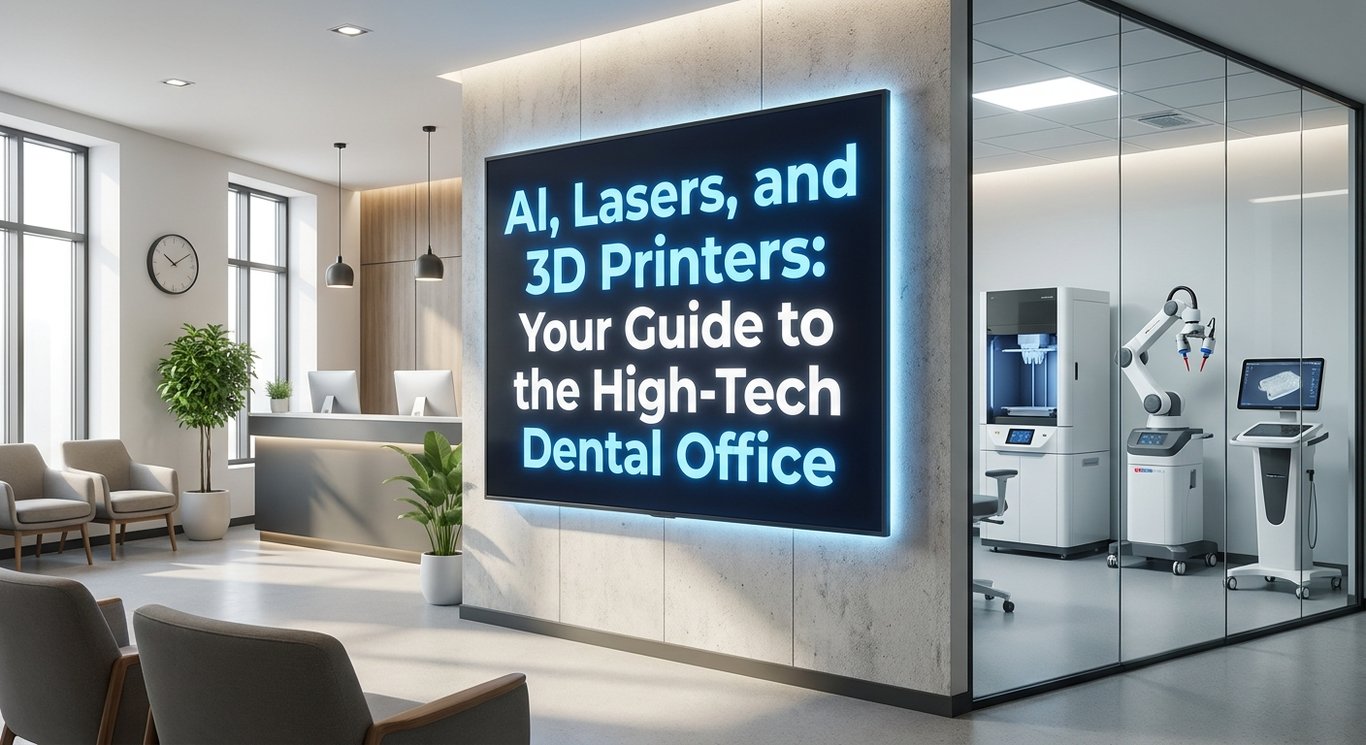
AI, Lasers, and 3D Printers: Your Guide to the High-Tech Dental Office
Published 25 min read
What Is a High-Tech Dental Office?
A high-tech dental office is one that uses advanced digital tools and systems to support patient care from the moment you walk in the door. Instead of relying entirely on traditional X-ray films and manual impressions, these practices bring together technologies like digital imaging, artificial intelligence, dental lasers, intraoral scanners, CAD/CAM systems, and 3D printers. Each of these tools plays a different role, but they are designed to work together as part of a connected, modern approach to dentistry. The result is a clinical environment where more information is available, more precisely, and often more quickly than ever before.
That said, it is important to understand what technology actually does in a dental office — and what it does not do. These tools support the dentist's work; they do not replace it. A dentist still conducts the examination, reviews your health history, talks with you about your concerns, interprets the data these systems produce, and makes every treatment decision. Technology can sharpen the picture, but the clinical judgment, communication, and care you receive still come from a trained human professional who is responsible for your health and wellbeing.
How Artificial Intelligence Is Changing Dentistry
Artificial intelligence is making its way into dental offices in some genuinely useful ways, particularly when it comes to reviewing dental images. AI software can be trained on large datasets of X-rays and photographs to identify patterns associated with cavities, bone loss, periodontal concerns, and other abnormalities. When a dentist takes a digital X-ray, an AI system can analyze that image almost instantly and highlight areas that may need closer attention. Think of it as a second set of eyes — one that never gets tired and has reviewed thousands of similar images before yours.
Beyond image review, AI is also being applied to treatment planning, risk assessment, and the day-to-day management of a dental practice. Some systems can help predict a patient's risk for certain oral health conditions based on their history, flag appointments that may need extra time, assist with clinical documentation, and even support teledentistry by helping evaluate images submitted remotely. Research in this area points to potential benefits in diagnostic consistency, workflow efficiency, and expanding access to care, particularly in areas where specialist availability is limited.
However, AI is not infallible, and its output must always be reviewed by a qualified dental professional before any clinical decision is made. These systems are only as good as the data they were trained on, which means they can reflect gaps, errors, or biases present in that data. There are also legitimate concerns about patient privacy, the transparency of how AI reaches its conclusions, and the risk of over-relying on automated recommendations. AI is a tool — a useful one — but it operates within a framework that requires professional oversight, critical thinking, and ethical accountability at every step.
Can AI Diagnose Dental Problems Without a Dentist?
The short answer is no. AI can flag patterns or highlight areas in an image that may look unusual, but flagging something is very different from diagnosing it. A proper dental diagnosis involves a complete clinical examination, a review of your medical and dental history, professional interpretation of findings in context, and a conversation with you about your symptoms, preferences, and goals. AI does not have access to all of that information, and it cannot replace the shared decision-making process between you and your dentist. It is a support tool, not a substitute for professional care.
Dental Lasers: How They Work
Dental lasers use concentrated beams of light energy to interact with tissue in very precise ways. Depending on the wavelength and the system being used, lasers can be applied to soft tissue procedures like gum contouring, periodontal treatment, and biopsies, as well as hard tissue applications such as cavity preparation. Some lasers are also used to manage cold sores or other oral lesions, and certain systems can assist with teeth whitening procedures. The key idea is that the laser delivers energy in a focused, controlled manner that can cut, reshape, remove, or disinfect tissue depending on the clinical goal.
The way a laser performs in a clinical setting depends on several factors working together. The wavelength of the laser determines what type of tissue it interacts with most effectively. Energy settings, pulse duration, and the technique used by the dentist all influence how the treatment feels, how the tissue responds, and how well the area heals afterward. This is why proper training matters so much — a laser in the hands of an experienced clinician who understands the science behind it is a very different thing from one used without that depth of knowledge. The technology itself is only part of the equation.
What Are the Benefits of Laser Dentistry?
One of the most commonly cited advantages of laser dentistry is the reduction in vibration and noise compared to some traditional dental instruments. For patients who feel anxious about the sound or sensation of a dental drill, this can make a real difference in their comfort during a procedure. Lasers also allow for targeted tissue treatment, meaning the clinician can focus the energy on a specific area with a relatively small impact on surrounding tissue. In soft-tissue procedures especially, lasers can improve visibility and reduce bleeding, which helps the dentist work more precisely.
Some patients who undergo laser procedures report less discomfort, less swelling, and a smoother recovery compared to their experiences with conventional methods. That said, outcomes are not universal. How a patient feels and heals after a laser procedure depends on the type of procedure, the specific laser system used, the patient's overall oral health, and individual factors that vary from person to person. It would be misleading to suggest that every patient will have the same experience, so it is worth having an honest conversation with your dentist about what to realistically expect.
It is also worth being clear that lasers are not automatically the best option for every dental procedure. There are many situations where conventional instruments — a scalpel, a drill, traditional periodontal tools — remain the most appropriate and effective choice. A good dentist selects the right tool for the right situation based on clinical evidence and the patient's specific needs, not simply because one option sounds more impressive than another. Technology should serve the treatment, not the other way around.
Is Laser Dentistry Safe and Pain-Free?
Dental lasers can be safe and effective when used by trained professionals who follow validated protocols, use appropriate protective equipment, and apply the correct settings for the procedure being performed. Like any clinical instrument, a laser used improperly can cause harm. That is why it matters that your dentist has received formal training in the specific laser system they use and understands how to apply it safely across different clinical scenarios. Regulatory oversight and manufacturer guidelines also play an important role in ensuring that laser systems meet safety standards before they are used in clinical practice.
As for the "pain-free" claim — that deserves a closer look. While some laser procedures can be performed with little or no anesthesia, local anesthesia is still necessary for many laser-assisted treatments, particularly those involving harder tissue or deeper areas. Every patient's pain threshold is different, and every procedure has its own demands. Before undergoing any laser treatment, it is reasonable to ask your dentist about their experience with the system, what the procedure involves, what level of discomfort you might feel, what the risks are, and whether a conventional alternative is available. An informed patient is always better positioned to make good decisions about their care.
3D Printers in the Dental Office
Dental 3D printing is exactly what it sounds like — using a digital file to produce a physical dental object, layer by layer, with a high degree of precision. Instead of sending an impression to a lab and waiting days for a model or appliance to come back, a dental office with a 3D printer can produce certain items in-house, often in a fraction of the time. These printed objects are customized to each patient based on digital scans of their mouth, which means the fit and design are tailored specifically to their anatomy.
The workflow typically starts with an intraoral scan, which creates a digital model of the patient's teeth and gums. That model is then imported into computer-aided design software, where the desired object — whether it is a crown, a surgical guide, a splint, or a model — is designed with precision. The design file is sent to the 3D printer, which builds the object using a dental-grade resin or other approved material. After printing, the object goes through washing, curing, and finishing steps before it is quality-checked and fitted in the patient's mouth. Applications span a wide range, including diagnostic models, night guards, dentures, orthodontic appliances, implant surgical guides, and crowns and bridges.
What Can a Dental 3D Printer Make?
On the more everyday end of the spectrum, dental 3D printers are commonly used to produce diagnostic models, orthodontic retainers, study casts, night guards, and occlusal devices. These are the kinds of appliances that many patients need at some point in their dental care, and 3D printing offers a way to produce them quickly and with a high level of customization. For orthodontic patients in particular, the ability to print precise models at different stages of treatment can make the process more efficient and easier to track over time.
Moving into more complex territory, 3D printing is also used to fabricate temporary crowns and bridges, full or partial dentures, surgical guides for implant placement, and customized prosthetic components. Surgical guides are especially valuable because they allow the dentist or oral surgeon to place implants with a higher degree of accuracy, reducing guesswork and improving outcomes. When a patient needs a temporary restoration while their permanent one is being made, an in-office 3D printer can sometimes produce that piece the same day, reducing the number of visits required.
Looking further ahead, researchers are exploring some exciting possibilities for 3D printing in dentistry that go well beyond what is currently available in most offices. Bioprinting — the idea of printing living tissue — is being studied in the context of bone repair, tissue regeneration, and even tooth reconstruction. Some early research suggests that these technologies could one day change how we approach certain types of oral surgery and tissue repair. However, it is important to distinguish between what is being explored in research settings and what is currently validated for routine clinical use. For now, bioprinting remains largely in the development phase.
Are 3D-Printed Dental Devices Safe?
Safety is a reasonable question to ask about any dental device, and 3D-printed ones are no exception. The safety of a printed dental appliance or restoration depends on multiple factors working together correctly: the quality and regulatory clearance of the printer, the type of resin or material used, the accuracy of the digital design, the postprocessing steps like washing and curing, sterilization procedures, the fit of the finished device, and compliance with both clinical standards and manufacturer requirements. When all of these elements are properly managed, 3D-printed dental devices can be safe and effective.
That said, the evidence base for different applications varies, and long-term outcomes data is still developing for some uses of dental 3D printing. Not all materials perform equally across different clinical situations, and cutting corners in the workflow — whether in design, printing, or postprocessing — can compromise the quality and safety of the final product. Validated materials, properly controlled workflows, and careful quality checks are not optional extras; they are essential to producing devices that patients can trust. If you are receiving a 3D-printed appliance or restoration, it is perfectly reasonable to ask about the materials used and the quality control process.
Digital Impressions and Same-Day Dentistry
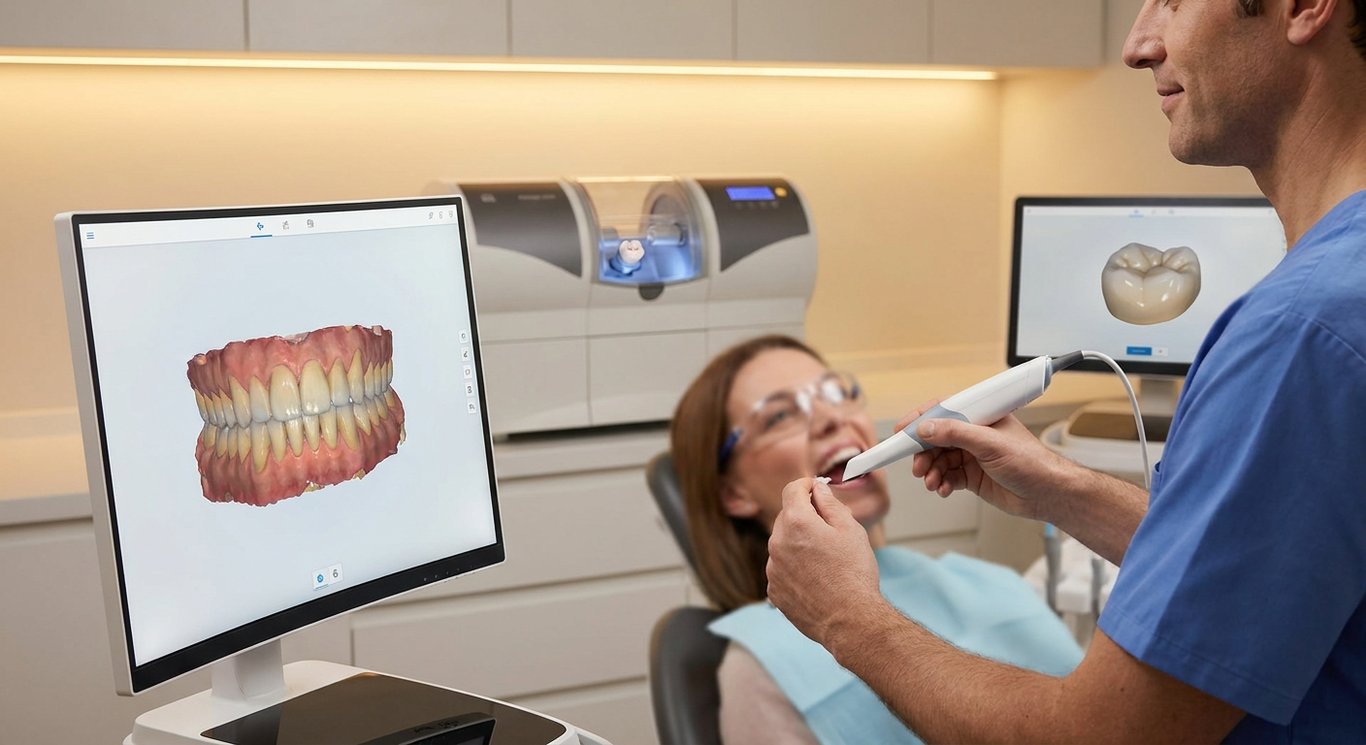
Traditional dental impressions — the kind where you bite down into a tray of goopy material and hold still for several minutes — have been a staple of dentistry for a long time. Digital impressions change that experience significantly. An intraoral scanner is a small wand that the dentist or hygienist moves around your mouth, capturing thousands of images per second to create a highly accurate three-dimensional digital model of your teeth and gums. No trays, no material, and no waiting for the impression to set. The result is a digital file that can be sent directly to CAD/CAM software or to a dental laboratory within minutes.
The advantages of this approach go beyond patient comfort, though that is certainly a benefit. Digital scans are easier to store, share, and compare over time than physical impressions. They can be sent to a dental lab electronically, which speeds up communication and reduces the risk of a model being damaged in transit. In offices equipped with in-house CAD/CAM milling units or 3D printers, a digital scan can sometimes lead to a same-day restoration, meaning a patient can have a crown designed, manufactured, and fitted in a single appointment. This is not possible in every case — it depends on the diagnosis, the complexity of the restoration, and the equipment available — but for many patients, it is a genuinely convenient option.
How AI, Lasers, and 3D Printing Work Together
To understand how these technologies connect in practice, it helps to walk through what a digital workflow might look like in a modern dental office. A patient comes in with a concern about a tooth. The dentist takes digital X-rays, and AI software reviews the images and highlights areas of interest. The dentist examines those areas, confirms the findings, and discusses treatment options with the patient. A digital intraoral scan is taken, and the data is imported into treatment planning software. If a laser is appropriate for part of the procedure — say, for treating the surrounding gum tissue — it is used at the appropriate stage. Afterward, the digital scan is used to design and print a surgical guide, a temporary restoration, or a custom appliance, depending on what the patient needs.
When these technologies are used together thoughtfully, they can improve coordination across the entire care team. The dentist can share digital images and scans with a specialist or a dental laboratory almost instantly, reducing delays and improving the accuracy of communication. Patients can see their own digital models on a screen, which makes it easier to understand what is happening in their mouth and why a particular treatment is being recommended. This kind of visual communication can lead to more meaningful conversations and better-informed decisions.
The most important thing to understand, though, is that technology should always be chosen based on clinical need — not because it is new or impressive. The right tool for a given patient is the one that best serves their diagnosis, their treatment goals, the available evidence, and their personal preferences. Cost, clinical suitability, and the dentist's experience with the technology all factor into that decision. A practice that chases every new gadget without a clear clinical rationale is not necessarily providing better care than one that uses a smaller set of tools very well.
Benefits for Patients
From a patient's perspective, one of the most tangible benefits of high-tech dentistry is better communication. Digital images, 3D scans, and computer-generated treatment simulations give dentists more powerful ways to explain what is happening in your mouth and what your options are. Instead of trying to interpret a flat X-ray image on your own, you might be looking at a rotating 3D model of your teeth on a screen while your dentist walks you through the treatment plan. That kind of clarity can make a real difference in how confident and comfortable you feel about your care.
Digital records also offer practical advantages when it comes to monitoring your oral health over time. Because digital scans and images can be stored and compared easily, your dentist can track subtle changes between appointments — slight shifts in tooth position, changes in bone density, or the early progression of a cavity — in ways that are harder to capture with traditional methods. This kind of longitudinal monitoring can support earlier intervention and more targeted preventive care, which is good for both your health and your wallet in the long run.
At the same time, it is important to go into high-tech dentistry with realistic expectations. Advanced technology does not eliminate the risks that come with any dental procedure, and it does not guarantee perfect results. Not every procedure will be faster or less expensive simply because a digital tool was involved. The goal of these technologies is to support better care, not to make dental treatment effortless or risk-free. Understanding that balance helps you evaluate your options more clearly and have more productive conversations with your dentist.
Costs, Insurance, and Access to High-Tech Dentistry
The cost of technology-assisted dental care can vary quite a bit depending on a number of factors. The specific technology being used, the complexity of the procedure, the materials involved, the dentist's level of training, whether a dental laboratory is part of the workflow, and the geographic location of the practice all play a role in determining what you will pay. In some cases, digital methods may reduce costs by streamlining the process or eliminating the need for multiple visits. In others, the investment in advanced equipment may be reflected in higher fees. There is no single answer that applies to every situation.
Before proceeding with any technology-assisted treatment, it is worth asking some specific financial questions. Does your insurance cover this procedure, and does it matter whether a traditional method was used instead? What is the out-of-pocket cost if insurance does not apply? If a device is 3D-printed or laser-treated and needs adjustment or replacement later, what is the policy on that? Are warranties offered? Is a conventional treatment option available that might be less expensive and equally effective? Getting clear answers to these questions before treatment begins helps you make a financially informed decision without surprises afterward.
Access is another dimension of this conversation that deserves honest attention. Not every dental practice has the resources to invest in AI software, laser systems, intraoral scanners, or 3D printers. These technologies are more commonly found in urban areas, specialty practices, and larger group practices than in rural or underserved communities. This creates a real concern: if advanced dental technology consistently reaches only certain populations, it risks deepening existing health and socioeconomic inequalities rather than addressing them. Thoughtful implementation of digital dentistry should include a commitment to making its benefits as broadly accessible as possible.
Privacy, Data Security, and Informed Consent
When a dental office uses AI software, digital scanners, intraoral cameras, or electronic health records, your personal health information is being collected, stored, and in some cases processed by third-party systems. This is not inherently a problem, but it is something patients should be aware of and ask about. Your dental data — including X-rays, scans, photographs, and clinical notes — is sensitive information, and the way it is handled matters. Data breaches in healthcare settings do happen, and the consequences for patients can be significant.
It is entirely reasonable to ask your dental office how your data is stored, who has access to it, whether any third-party software companies are involved in processing it, and what security measures are in place to protect it. You should also ask whether your data is used for any purposes beyond your direct care, such as training AI systems or contributing to research databases. These are not paranoid questions — they are the kinds of questions any informed patient should feel comfortable raising, and a reputable practice should be able to answer them clearly.
Informed consent in a high-tech dental office should cover more than just the clinical procedure itself. If a technology-assisted tool is part of your care, you have the right to understand what it does, what its limitations are, what the known risks are, and what alternatives exist. You should also understand that even when AI or other digital tools are involved, your dentist remains personally responsible for the final decisions about your care. Ethical use of dental technology requires transparency, accountability, and a genuine respect for each patient's right to understand and agree to the care they receive.

How to Choose a High-Tech Dental Office
Choosing a dental office based on its technology alone is a bit like choosing a restaurant because the kitchen has expensive equipment. What really matters is what comes out of it. When evaluating a high-tech dental practice, start by looking at the dentist's credentials and training — specifically in the technologies they use. Continuing education in AI-assisted diagnostics, laser dentistry, or digital prosthetics is a meaningful indicator that a clinician is applying these tools thoughtfully rather than just marketing them. You should also ask about sterilization procedures, emergency protocols, and whether the materials and equipment used are validated and approved for clinical use.
Once you are in a consultation, ask questions that get beyond the surface level. Does using this technology change what treatment you are recommending, and if so, how? How are the results verified? If AI flags something on my X-ray, who reviews that finding and how is the final call made? Does the practice work with qualified dental laboratories for cases that require outside fabrication? These questions help you understand whether the technology is being used as a genuine clinical asset or simply as a selling point.
Finally, resist the urge to choose a practice based purely on the impressiveness of its equipment. Instead, compare treatment plans, costs, alternatives, expected outcomes, and follow-up care across the options available to you. A dentist who uses a smaller set of technologies with great skill and clear clinical reasoning may serve you better than one who has every available gadget but applies them without the same level of judgment. The best dental care — high-tech or otherwise — is always grounded in accurate diagnosis, honest communication, and genuine attention to your health.
Common Myths About AI, Lasers, and 3D Printers
One of the most persistent myths about AI in dentistry is that it can independently diagnose and treat patients. This misunderstanding likely comes from the way AI is sometimes described in marketing materials, where the language can make it sound more autonomous than it actually is. In reality, AI is an assistive tool — it can analyze images and flag areas of concern, but it does not examine patients, take health histories, consider the full clinical picture, or make treatment decisions. Every output from an AI system must be reviewed and interpreted by a qualified dental professional. The dentist, not the algorithm, is responsible for your care.
Another common misconception is that lasers eliminate pain entirely or can replace every traditional dental instrument. While laser dentistry does offer genuine advantages in certain situations — reduced vibration, less bleeding in soft-tissue procedures, targeted treatment — it is not a universal pain eliminator. Many laser procedures still require local anesthesia, and the benefits of laser treatment depend heavily on the specific procedure, the patient's anatomy, and the skill of the clinician. Lasers are a valuable addition to the dental toolkit, but they work alongside conventional instruments, not instead of them.
When it comes to 3D printing, a common assumption is that anything produced by a high-tech printer is automatically precise, durable, and superior to traditionally made alternatives. That is not always the case. The quality of a 3D-printed dental device depends on the material selected, how the design was created, the accuracy of the printing process, and the postprocessing steps that follow. A poorly designed or improperly finished 3D-printed restoration can fail just as surely as any other poorly made dental device. Material selection, clinical validation, and careful quality control are what determine whether a printed device is safe and effective — not the fact that it came from a printer.
Questions to Ask Before Technology-Assisted Treatment
Going into any dental procedure with good questions prepared is always a smart move, and technology-assisted treatments are no exception. Before you agree to a procedure that involves AI, lasers, or 3D printing, consider asking: What specific technology will be used, and what is its purpose in my treatment? How experienced are you with this system, and what training have you completed? What benefits can I realistically expect, and what are the possible risks or limitations? Are there alternative approaches that do not involve this technology, and how do the outcomes compare? What does recovery look like, and when will I need follow-up care?
Financial and privacy questions are equally important and should not feel awkward to raise. Will using this technology change the cost of my treatment compared to a conventional approach? Does my insurance cover it, and if not, what are my out-of-pocket costs? If a device needs to be adjusted or replaced, who is responsible for that cost? How are my digital records — including scans, images, and AI-generated findings — stored and protected? Who has access to that data, and is any of it shared with third parties? A dental office that welcomes these questions and answers them clearly is one that takes patient-centered care seriously.
Frequently Asked Questions
What is AI used for in dentistry?
AI in dentistry is most commonly used to assist with the analysis of dental images, including X-rays and photographs, by identifying patterns that may indicate cavities, bone loss, or other concerns. It is also being applied to risk assessment, treatment planning support, clinical documentation, appointment workflow management, and teledentistry applications. In all of these roles, AI functions as an assistive tool — it provides information and highlights areas of interest, but the dentist remains responsible for interpreting findings, making clinical decisions, and delivering care.
Do dental lasers hurt less than traditional dental tools?
Some laser procedures may reduce vibration, noise, and bleeding compared to certain traditional instruments, and some patients do report less discomfort during and after laser treatments. However, pain levels vary considerably depending on the procedure, the patient, and the specific laser system used. Local anesthesia is still necessary for many laser procedures, particularly those involving harder tissue or deeper areas. It is best to discuss your specific procedure with your dentist to get a realistic sense of what to expect rather than assuming lasers will be completely pain-free.
What are dental 3D printers used for?
Dental 3D printers are used to produce a wide range of customized items, including diagnostic models, orthodontic retainers and appliances, night guards, surgical guides for implant placement, temporary crowns and bridges, full and partial dentures, and implant planning components. The specific applications available in a given office depend on the type of printer, the materials it uses, and the software it works with. As the technology continues to develop, the range of clinically validated applications is expanding, though some uses remain in the research and development phase.
Can a high-tech dental office complete treatment in one visit?
Same-day treatment is possible in certain cases, particularly when a practice has both intraoral scanning capability and in-house CAD/CAM manufacturing or 3D printing. For example, some offices can design, fabricate, and fit a crown in a single appointment using this technology. However, whether same-day treatment is appropriate depends on the specific diagnosis, the complexity of the restoration, the materials required, the design process, and the patient's individual needs. Not every case is suitable for a one-visit approach, and some treatments will still require multiple appointments regardless of the technology available.
Is high-tech dentistry better than traditional dentistry?
High-tech dentistry is not inherently better than traditional dentistry — it depends entirely on the clinical situation. In the right circumstances, digital tools can improve treatment planning, enhance communication, increase precision, and make certain procedures more efficient. But the quality of any dental care ultimately comes down to accurate diagnosis, professional skill, sound clinical judgment, and a genuine commitment to the patient's wellbeing. Technology can support all of those things, but it cannot replace them. A highly skilled dentist using well-chosen tools — whether high-tech or conventional — will consistently deliver better outcomes than one who relies on equipment alone.
Conclusion: Making Sense of the High-Tech Dental Office
Modern dental technology has genuinely changed what is possible in a dental office. AI can assist with reviewing images and identifying areas that may need attention. Lasers can provide targeted, precise treatment for selected soft- and hard-tissue procedures. And 3D printers can produce customized models, appliances, surgical guides, and restorations with a level of speed and personalization that was not possible even a decade ago. Each of these technologies brings real benefits to the right clinical situations — and each comes with its own limitations, costs, and safety considerations that patients deserve to understand clearly.
Use this guide — "AI, Lasers, and 3D Printers: Your Guide to the High-Tech Dental Office" — as a starting point when you are comparing practices, preparing for a consultation, or trying to make sense of a treatment recommendation that involves digital tools. Ask the questions outlined here. Review your alternatives. Look beyond the equipment and evaluate the dentist's training, judgment, and commitment to your care. The best dental office for you is one that combines advanced tools with sound clinical reasoning and puts your health — not its technology — at the center of every decision. If you are ready to take the next step, schedule a consultation with a qualified dental professional and go in prepared to have an informed, confident conversation about your options.